

Blog
The Best Indoor Air Quality Monitors
Indoor air quality can have a major impact on the comfort and productivity of homes, offices, schools, laboratories, and industrial facilities. Carbon dioxide buildup, poor





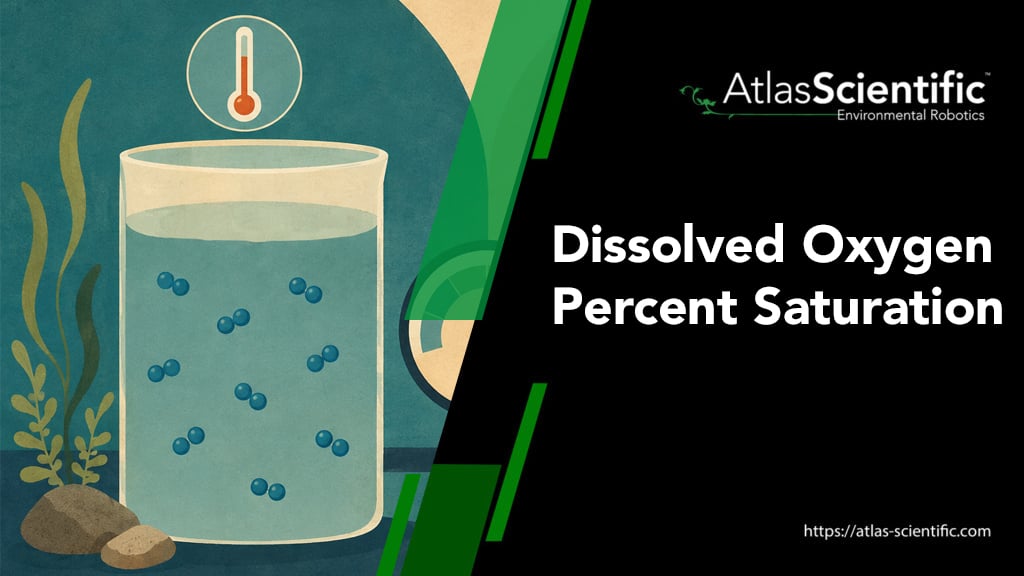
Dissolved oxygen percentage saturation measures the actual amount of oxygen gas dissolved in water compared to the maximum amount that the water could potentially hold at that specific temperature, salinity, and pressure. It is important for identifying pollution, understanding aquatic ecosystem health and photosynthetic activity, and evaluating stress levels. It is measured using modern digital meters to calculate the percentage.
Unless you are new to monitoring parameters, you will already know that dissolved oxygen (DO) is a critical parameter. Whether you are running an aquaculture operation, managing a wastewater treatment plant, fermenting something at a precise biological tolerance, or monitoring water quality in a natural waterway, DO is one of those parameters that sits at the center of everything.
One thing many people don’t know much about, even engineers and scientists, is percent saturation. And if you are not measuring percent saturation alongside DO concentration, you could be making decisions in your application with incomplete data. In this article, we will look at what dissolved oxygen percentage saturation is and how to interpret it alongside your readings.
Dissolved oxygen percent saturation tells you how much oxygen is actually dissolved in your water compared to the equilibrium solubility under the current temperature, salinity, and pressure. It is the percentage ratio of measured dissolved oxygen to the equilibrium saturation concentration under current conditions.
At 100% saturation, your water is holding as much dissolved oxygen as it can at equilibrium under its current temperature, salinity, and barometric pressure. Anything over 100% and you are in the realm of supersaturation, something that occurs naturally through photosynthesis or can happen during rapid temperature change. If it’s less than 100%, your water is undersaturated, meaning there’s oxygen capacity still available.
This is the equation:
% Saturation = (Measured DO / Saturation DO at Current Conditions) x 100
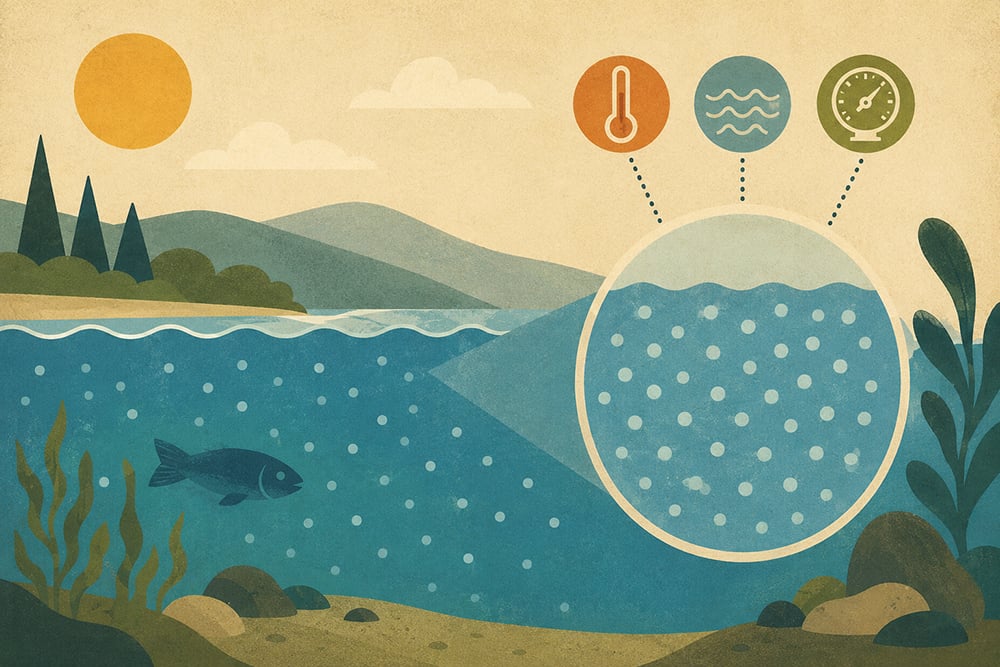
NOTE: The DO saturation value in the denominator is very sensitive to three physical variables (temperature, salinity, and barometric pressure). Each one can dramatically shift what ‘normal’ looks like, so keep this in mind.
Three main variables that affect dissolved oxygen in water.
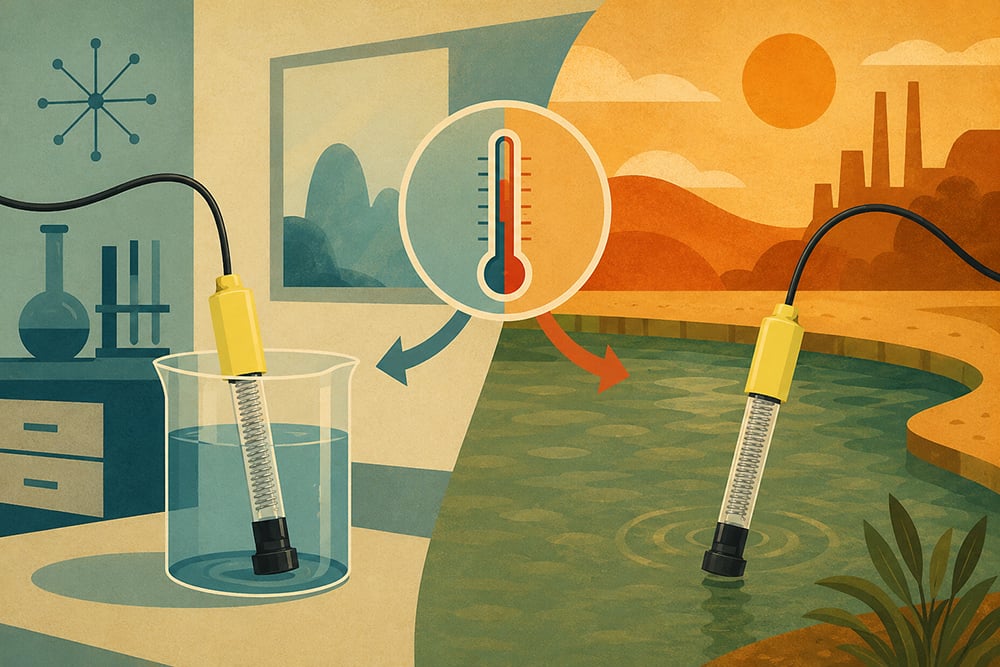
The oxygen-water relationship is counterintuitive. Water is capable of holding more dissolved oxygen as temperature decreases; therefore, cold water holds more oxygen than warm water.
At 0°C, the saturation level of dissolved oxygen in fresh water is about 14.6 mg/L. By the time you get to 30°C, that number is around 7.5 mg/L; this is barely half. This is why warm summer months are especially stressful for aquatic ecosystems and why fish kills are more common during heat events. Warmer water holds less oxygen at the same time that fish metabolic demand increases, creating conditions where oxygen stress can develop rapidly.
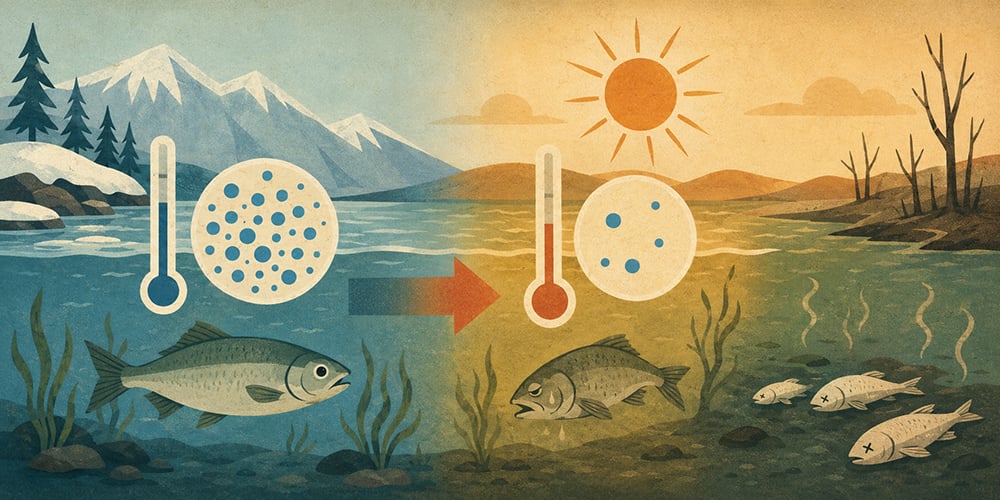
An 8 mg/L reading at 10°C corresponds to roughly 70% saturation, whereas at 25°C it is close to saturation (~95–100%). Same concentration, very different physiological meaning.
Salt ions compete with the oxygen molecules for space in solution. As salinity increases, the ability of water to hold oxygen decreases. This is called the “salting-out effect.” Seawater typically reaches saturation about 15-25% lower DO than freshwater at the same temperature.
This renders salinity correction unavoidable in marine aquaculture, coastal monitoring, and estuarine research. If you are measuring percent saturation in a brackish or marine environment and are not correcting for salinity, your saturation values are systematically incorrect, as may be your corrective actions.
The higher we go in altitude, the lower the atmospheric pressure, and therefore the less the partial pressure of oxygen above the surface of the water. At lower partial pressure, less oxygen is dissolved in the water. Even if two lakes have the same temperature and salinity, a lake 3,000 meters above sea level will have a lower oxygen saturation ceiling than an identical lake at sea level.
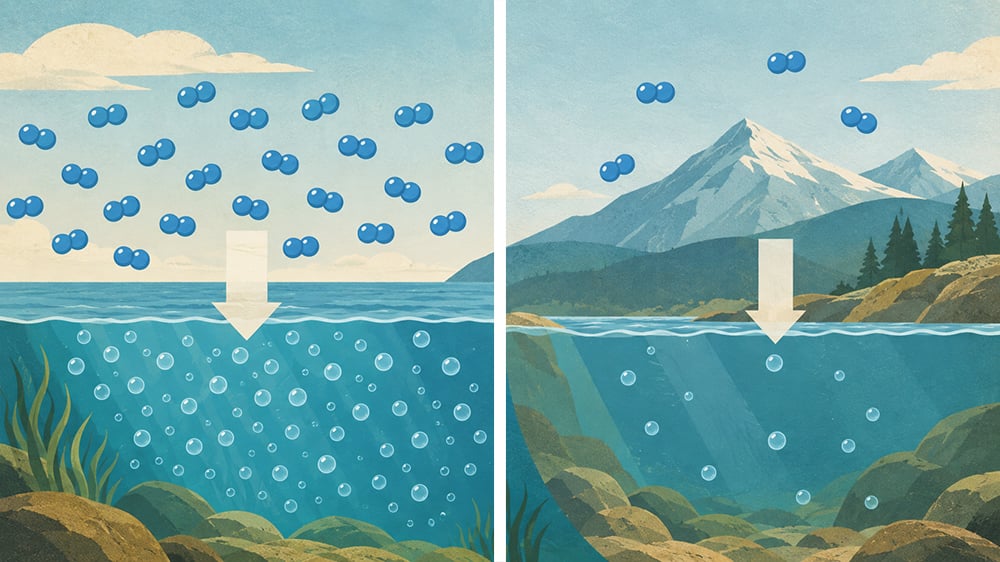
This altitude effect can catch people unprepared when equipment is transferred between facilities at different elevations, or when monitoring systems are deployed in mountainous or highland regions. Barometric pressure changes day to day with weather patterns, so even at sea level, a low-pressure storm system can meaningfully depress your saturation maximum.
Milligrams per liter tells you how much oxygen is present. Percent saturation tells you where you sit relative to equilibrium with the atmosphere, and it’s that equilibrium context that drives the physical chemistry of oxygen exchange.
In natural waters, percent saturation is a useful indicator of photosynthetic activity and biological oxygen demand (BOD). Supersaturated (>100%) water may indicate very active photosynthesis by algae or plants. If the water is undersaturated (<80%), this may indicate excessive biological oxygen demand, organic loading, or stratification. Percent saturation helps diagnose what’s really happening in the system.

Both measures are important in aquaculture, but percent saturation provides a clearer picture of fish welfare as temperature conditions vary. For salmonids, for example, they typically don’t do well unless above 85-90% saturation. Many species have saturation-based thresholds and those thresholds are more consistent across temperature changes than fixed mg/L targets.
Aeration systems in wastewater treatment are typically controlled to a target DO, mg/L, concentration. Knowing about saturation helps you design and troubleshoot aeration efficiency. The process tank is 15°C. A diffuser system that achieves 100% saturation at 15°C delivers much more mass oxygen than the same percent saturation at 30°C.
In fermentation and bioprocessing, percent saturation is often the controlled variable because dissolved oxygen is commonly reported as a percentage of air saturation rather than absolute concentration. In this context it is often called dissolved oxygen tension (DOT).

To calculate percent saturation correctly means having accurate values for temperature, salinity, and barometric pressure at the time of measurement, not estimated, not assumed from historical averages, but measured. A 2°C error in temperature can materially affect calculations, especially at higher temperatures or precision-sensitive applications.
This is where many monitoring setups go wrong. They measure the DO concentration but calculate the saturation from assumed or imprecise environmental parameters. The right way to do this is either to use some multi-parameter sensor that measures all relevant conditions at once, or to carefully characterize your measurement environment before applying saturation corrections.
The Atlas Scientific Dissolved Oxygen Calculator is a great tool to build your intuition and check your expected values against those measured. If you want to see the correlation between these variables in real time, and see how the saturation threshold shifts as a change in temperature, salinity, and pressure.
Air calibration: for Atlas Scientific galvanic dissolved oxygen probes, the high-point calibration is performed by leaving the probe exposed to air until the reading stabilizes, then issuing the air calibration command. Temperature, pressure, and salinity compensation should be applied after calibration.
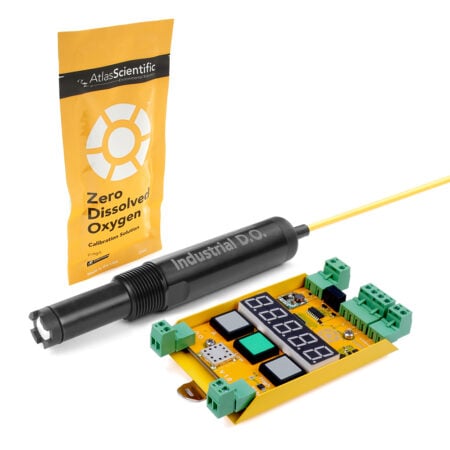
A zero-point calibration can also be performed using Atlas Scientific Zero Dissolved Oxygen Calibration Solution. This second calibration point is optional and is particularly useful when accurate measurements below 1 mg/L are required.
What you want to avoid is calibrating in one temperature environment and then measuring in a substantially different one without correcting for the temperature dependence of the sensor response. This concern has been much relieved by modern DO sensors in contrast to the older polarographic sensors, but it is still good to know the temperature coefficients of your particular sensor.
Some benchmarks that are useful across most applications:
These ranges vary by species, application, and temperature, but give you a working framework for triage.
Dissolved oxygen percent saturation is not a substitute for concentration measurement. DO concentration tells you how much oxygen is present, while percent saturation tells you how that amount compares against the physical limits imposed by your current conditions.
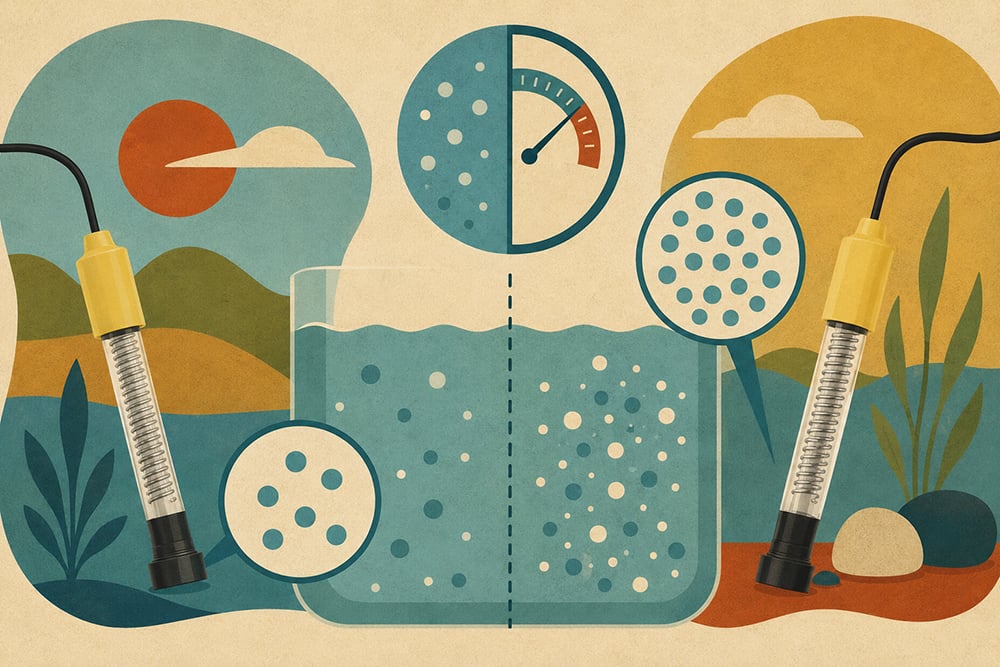
If you’re only reporting mg/L, you don’t have the context to make those numbers meaningful. If you’re only reporting percent saturation, and you don’t know the underlying temperature, salinity, and pressure conditions that were used to calculate it, you have a number without a foundation. The aim is both accurately measured, carefully calibrated, and properly interpreted.
The physics is the same. Oxygen still diffuses down its concentration gradient. Biological systems still live or die based on availability. And your process still works better when you know the whole oxygen story rather than just part of it.
If you need help measuring dissolved oxygen, from sensor selection and monitoring system design, to troubleshooting strange readings and interpreting your saturation data, the world-class team at Atlas Scientific is here to help.



Indoor air quality can have a major impact on the comfort and productivity of homes, offices, schools, laboratories, and industrial facilities. Carbon dioxide buildup, poor

UART and I2C are serial communication protocols, but they serve different purposes. UART is typically used for direct device-to-device communication and requires dedicated connections. I2C