

Blog
The Best Industrial Conductivity Transmitters
Conductivity is one of the most important measurements in industrial water systems. From water treatment and hydroponics to chemical processing and manufacturing, conductivity provides a




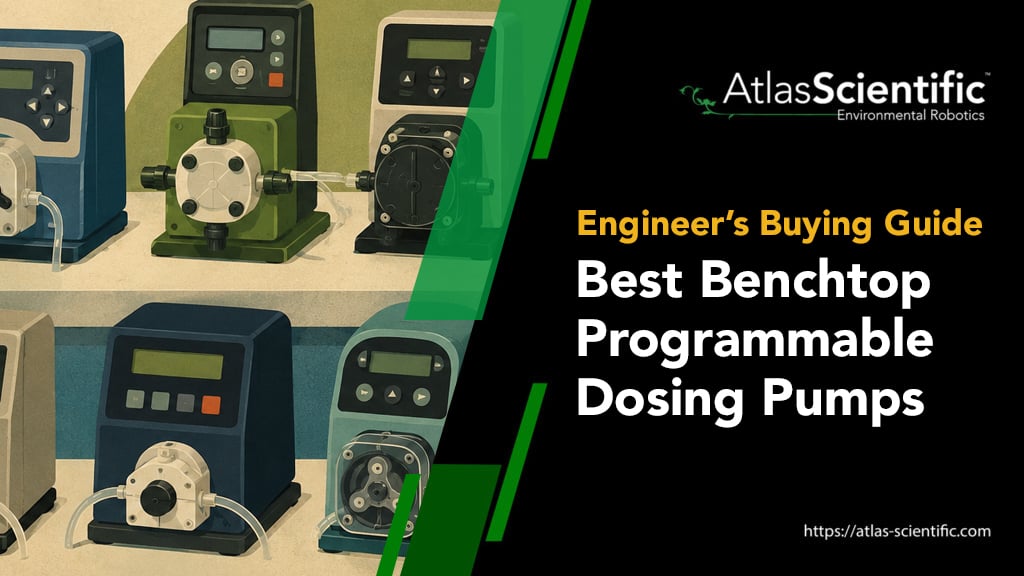
Accurate liquid dosing is essential in laboratories, water treatment systems, hydroponics, aquariums, chemical processing, research applications, and automated manufacturing. While a basic peristaltic pump can move liquid from one place to another, a programmable dosing pump goes a step further by allowing the operator to dispense controlled quantities of liquid repeatedly and accurately.
The problem is that benchtop dosing pumps vary enormously in complexity and price. Some are sophisticated laboratory instruments with touchscreen interfaces, interchangeable pump heads, and extensive programming options. Others require external controllers or additional hardware before they can perform automated dosing.
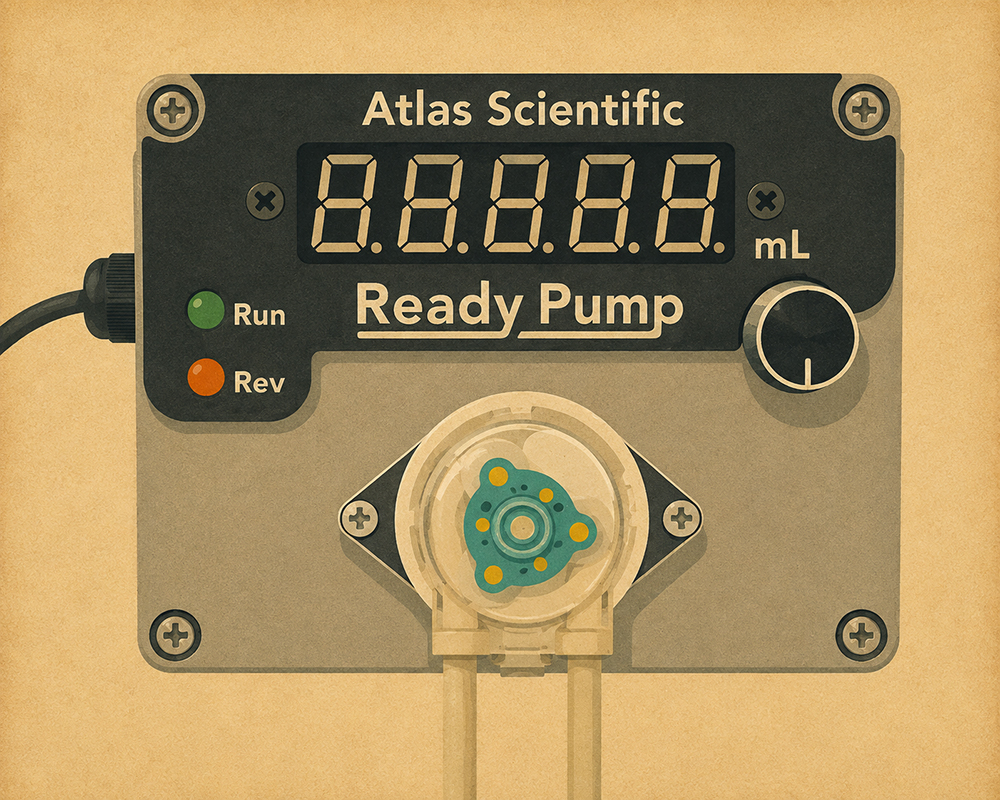
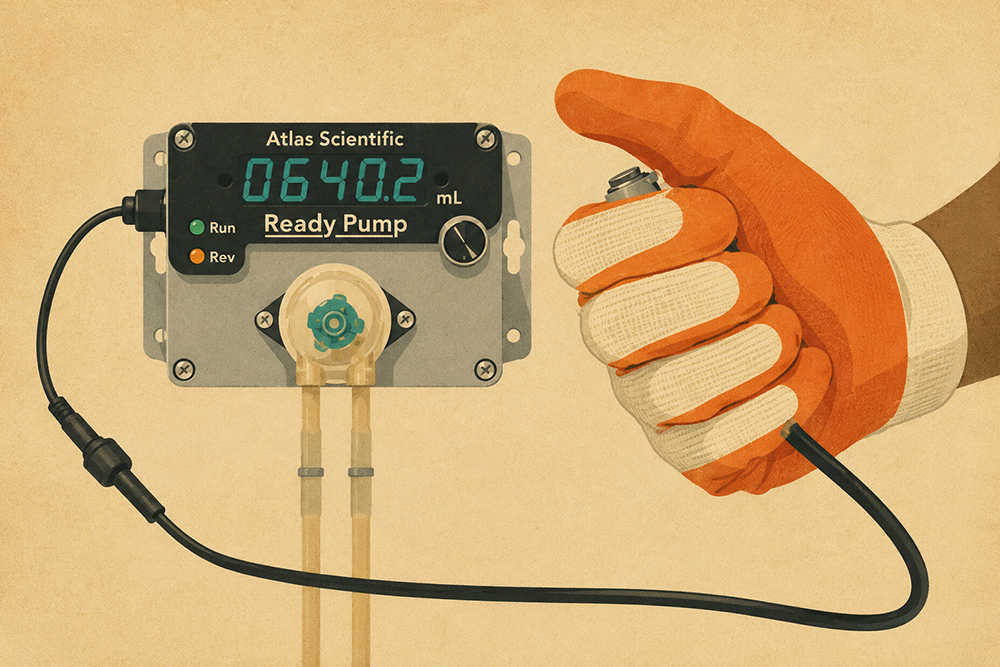
For users who primarily need accurate, repeatable dosing without a complicated setup, the Atlas Scientific Ready Pump takes a different approach: set the amount you want to dispense and run the pump.
We compared the Atlas Scientific Ready Pump against several alternatives, including the LongerPump BT100-1F, Golander BT100L, and Heidolph Hei-FLOW Expert 120, to determine which offers the best combination of accuracy, programmability, automation capability, simplicity, and value.

The Atlas Scientific Ready Pump wins this comparison because it concentrates on what many users actually want from a benchtop dosing pump: tell the pump how much liquid to dispense and let it handle the rest.
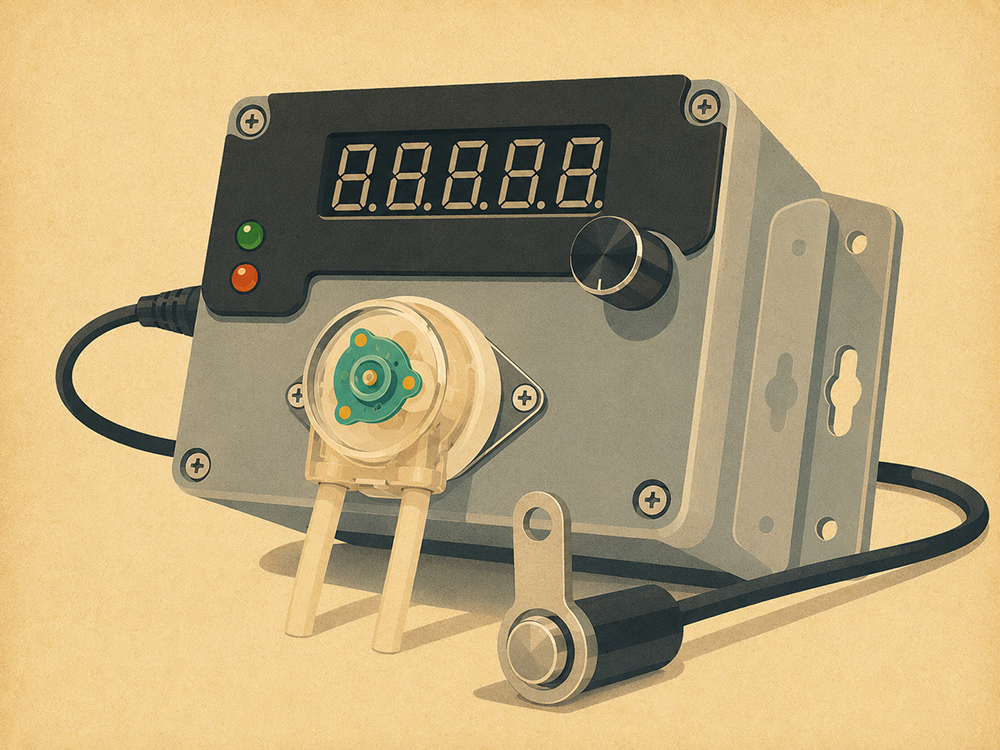
The Ready Pump is a compact, self-contained peristaltic dosing system. Unlike more traditional laboratory pump drives that require users to select pump heads, tubing combinations, RPM settings, and other parameters, the Ready Pump arrives as a much more integrated solution.
Its programmable dosing range extends from 0.5 mL all the way to 10 liters, with a resolution of 0.1 mL and stated accuracy of ±1%. It can also operate continuously at 105 mL/min with water.
One of its biggest advantages is simplicity.
The operator can set the desired dispensing amount directly through the pump’s interface without writing a computer program. Atlas Scientific specifically designed the system so that dosing can be configured through the onboard interface.
But simple doesn’t mean the Ready Pump is limited to manual operation.
The pump can also be controlled by a PLC or microcontroller, making it equally useful as a standalone benchtop instrument or as part of a larger automated system.
That creates an unusually useful middle ground between basic standalone pumps and substantially more expensive laboratory pumping systems.
The supplied tubing is Tygon A-60-F and is NSF/ANSI 51 food-safe compliant. The pump also provides an impressive 8.1-meter (26.5-foot) pump head and uses a straightforward single-point calibration procedure.
Perhaps the biggest differentiator, however, is price.
Atlas Scientific currently lists the Ready Pump at $199.99, dramatically below many traditional programmable laboratory peristaltic pumps.
The Ready Pump isn’t designed to replace every laboratory pump. Applications requiring extremely low microliter-scale flow rates, multiple channels, interchangeable pump heads, sophisticated multi-step programs, or very high continuous flow rates may be better served by a more specialized laboratory pump.
Best overall benchtop programmable dosing pump for users who prioritize accurate dosing, simplicity, automation capability, and value.
The LongerPump BT100-1F is a significantly more complex laboratory dispensing pump.
It offers continuous and multi-dispensing modes and supports numerous interchangeable pump heads. Depending on the selected pump head and tubing, flow can reach 500 mL/min. Its programmable dispensing range extends from 0.01 mL to 9.99 L.
The BT100-1F also provides features the Ready Pump doesn’t attempt to replicate, including copy counts from 1 to 9,999, programmable pause times, back-suction settings, RS485 communication, and multiple external-control options.
That’s excellent for laboratories requiring complicated repetitive filling routines.
However, additional capability comes with additional complexity and cost.
A current listing puts the BT100-1F around $1,169, more than five times the Ready Pump’s current direct price.
The BT100-1F is the stronger choice for users requiring complex repetitive laboratory dispensing programs.
For straightforward programmable dosing, however, the Ready Pump delivers the core functionality at a fraction of the cost.
The Golander BT100L takes another approach. It’s a highly configurable laboratory peristaltic pump built around interchangeable pump heads and tubing.
Depending on configuration, Golander specifies an extremely broad 0.00011–720 mL/min flow range, along with a speed range of 0.1–150 RPM and ±0.2% rotating-speed accuracy.
The BT100L also offers flow calibration, time dispensing, anti-drip functionality, external control, and RS485 MODBUS, making it particularly attractive for sophisticated laboratory automation.
That flexibility is impressive.
But users primarily looking for a simple dosing appliance may find themselves paying for capabilities they don’t actually need.
A current retail listing puts the BT100L around $1,150.
For laboratories needing maximum pump-head and flow-rate flexibility, the BT100L is impressive.
For users who simply need to repeatedly dispense known volumes of liquid, the Ready Pump provides a much simpler and more economical solution.
The Heidolph Hei-FLOW Expert 120 is a professional laboratory peristaltic pump designed primarily around controlled continuous pumping.
With the appropriate head, Heidolph specifies 0.5–936 mL/min for single-channel operation and as low as 0.005 mL/min with multi-channel configurations. It also provides analog external control and supports continuous 24/7 operation.
That makes the Hei-FLOW Expert particularly attractive for continuous laboratory processes.
But there is an important distinction.
Heidolph’s specifications list no volume-dosing or interval-dosing function for the Expert 120.
Therefore, while it’s an excellent laboratory peristaltic pump, it isn’t as directly focused on standalone programmable volumetric dispensing as the Ready Pump.
Choose the Hei-FLOW Expert 120 when continuous laboratory pumping and pump-head flexibility are more important than simple programmable dosing.
For measured batch dispensing, the Ready Pump is the more straightforward tool.
| Feature | Atlas Scientific Ready Pump | LongerPump BT100-1F | Golander BT100L | Heidolph Hei-FLOW Expert 120 |
|---|---|---|---|---|
| Pump Type | Peristaltic dosing pump | Peristaltic dispensing pump | Intelligent peristaltic pump | Laboratory peristaltic pump |
| Programmable Dispensing | Yes | Yes | Yes – time dispense | No dedicated volume dosing |
| Programmable Dose Range | 0.5 mL–10 L | 0.01 mL–9.99 L | Configuration dependent | — |
| Continuous Flow | 105 mL/min with water | Up to 500 mL/min depending on head/tubing | Up to 720 mL/min depending on head/tubing | Up to 936 mL/min single-channel |
| Stated Accuracy / Precision* | ±1% accuracy | Calibration supported; configuration dependent | ±0.2% speed accuracy | ±3.5% precision |
| Dose Resolution | 0.1 mL | Configuration dependent | Configuration dependent | — |
| Standalone Controls | Yes | Yes | Yes | Yes |
| External Machine Control | PLC or microcontroller | External control / RS485 | External control / RS485 MODBUS | Analog control |
| Calibration | Single-point | Flow + dispensing calibration | Flow calibration | — |
| Supplied Tubing | Tygon A-60-F | Depends on configuration | Depends on configuration | Depends on pump head |
| Food-Safe Tubing | NSF/ANSI 51 compliant | Depends on selected tubing | Depends on selected tubing | Depends on selected tubing |
| IP Rating | IP61 | IP31 | IP31 | IP54 |
| Approx. Pump Price** | $199.99 | ~$1,169 | ~$1,150 | ~$3,580 at one current retailer |
| Best For | Simple precision dosing & automation | Advanced laboratory dispensing | Flexible laboratory flow control | High-flow laboratory pumping |
Looking purely at maximum flow rate or the number of advanced configuration options would miss the point of this comparison.
A good dosing pump shouldn’t necessarily be the pump with the longest specification sheet.
It should be the pump that makes accurate dosing easy.
That’s where the Atlas Scientific Ready Pump separates itself from the competition.
Instead of forcing users to think primarily in terms of motor speed, tubing dimensions, and pump-head combinations, the Ready Pump allows the operator to concentrate on the desired result:
How much liquid should be dispensed?
Set the dose and run the pump.
For routine chemical additions, nutrient dosing, water treatment, research experiments, reagent dispensing, and prototype automation, that’s often exactly what’s required.
A single Ready Pump can handle doses ranging from 0.5 mL to 10 L.
That means the same basic platform can perform small-volume dosing while still handling comparatively large dispensing jobs.
Atlas Scientific specifies the Ready Pump at ±1% accuracy, following calibration.
That makes it suitable for applications where repeatable dosing matters without requiring the cost and complexity associated with many high-end laboratory systems.
The Ready Pump doesn’t lock users into one control method.
It can be operated directly by a person through its controls or connected to a microcontroller or PLC for machine-controlled dosing.
This makes it particularly attractive to engineers developing automated systems.
A project can start with simple manual dosing and later transition into automated control without replacing the pump.
Not every laboratory technician, aquaculture operator, researcher, or water-treatment professional wants to program a pump before dispensing liquid.
The Ready Pump’s onboard interface allows the dispensing dose to be configured without computer programming.
That’s a major practical advantage.
The Atlas Scientific Ready Pump is currently listed at $199.99 directly from Atlas Scientific.
Compare that with current listings around $1,150–$1,169 for two of the more sophisticated competing laboratory systems in this comparison.
Those more expensive systems absolutely have applications where their additional capabilities justify the investment.
But if the goal is simply:
accurately dispense a programmed amount of liquid,
the Ready Pump offers an exceptional amount of functionality for the money.
The right pump ultimately depends on the application.
Choose the LongerPump BT100-1F when sophisticated repetitive dispensing sequences, adjustable pause times, back suction, and multiple pump-head options are essential.
Choose the Golander BT100L when an extremely broad flow range, multiple pump heads, MODBUS communication, and laboratory automation flexibility are the priorities.
Choose the Heidolph Hei-FLOW Expert 120 when you need a robust laboratory pump primarily for continuous operation and higher flow rates.
But for engineers, laboratories, hydroponic systems, water-quality applications, automated prototypes, and other users looking for a compact programmable dosing pump that works without unnecessary complexity, our winner is the Atlas Scientific Ready Pump.
The Ready Pump doesn’t win because it has the highest maximum flow rate or the most complicated interface.
It wins because it delivers the features most users actually need—accurate programmable dosing, simple operation, calibration, standalone control, machine integration, and a remarkably accessible price—in one compact package.
At $199.99, with ±1% accuracy, 0.1 mL resolution, 0.5 mL–10 L programmable dosing, PLC/microcontroller compatibility, food-safe supplied tubing, and no programming required for normal standalone operation, the Atlas Scientific Ready Pump offers an unusually strong combination of performance and value.
For applications where the objective is simply to set a dose, commence operation, and dispense accurately, the Atlas Scientific Ready Pump is our Best Overall Benchtop Programmable Dosing Pump.
Conductivity is one of the most important measurements in industrial water systems. From water treatment and hydroponics to chemical processing and manufacturing, conductivity provides a

When a process requires more than one chemical, nutrient, reagent, or additive, using several independent dosing pumps can quickly become complicated. A multi-pump dosing system