



Blog
The Best Industrial Conductivity Transmitters
Conductivity is one of the most important measurements in industrial water systems. From water treatment and hydroponics to chemical processing and manufacturing, conductivity provides a






A color sensor detects and measures the color of an object or liquid by analyzing the light it reflects or transmits. Using red, green, and blue (RGB) channels, it converts light into digital data that can be used to identify colors, monitor changes, ensure consistency, and automate quality control across industrial, environmental, and scientific applications.
Color is found everywhere. We use color to tell us when fruit is ripe to eat, when a warning light demands attention, and whether paint on a production line matches the approved shade. But how does a machine detect color the way our eyes can? The answer boils down to remarkable technology, the color sensor.
In this article, we will explore how color sensors work, why RGB is the typical standard for color management, why they are key in water and liquid monitoring, and where Atlas Scientific’s RGB color sensors take effect.
Before diving into how color sensors work, we need to understand what color is truly.
Color is not a property of an object; it is a property of light. Visible light is made up of electromagnetic radiation with wavelengths that range from around 380 nm (violet) to 750 nm (red). When light hits an object, some wavelengths are absorbed, while others are reflected. It is the reflected wavelengths that we see as color.

For example, a ripe tomato looks red because its surface absorbs most wavelengths of light and reflects those in the red range. A clear sky looks blue because the atmosphere scatters shorter blue wavelengths more than longer ones. Everything we see is just reflecting light arriving at our eyes, or in a color sensor, the reflected light arriving at the detector.
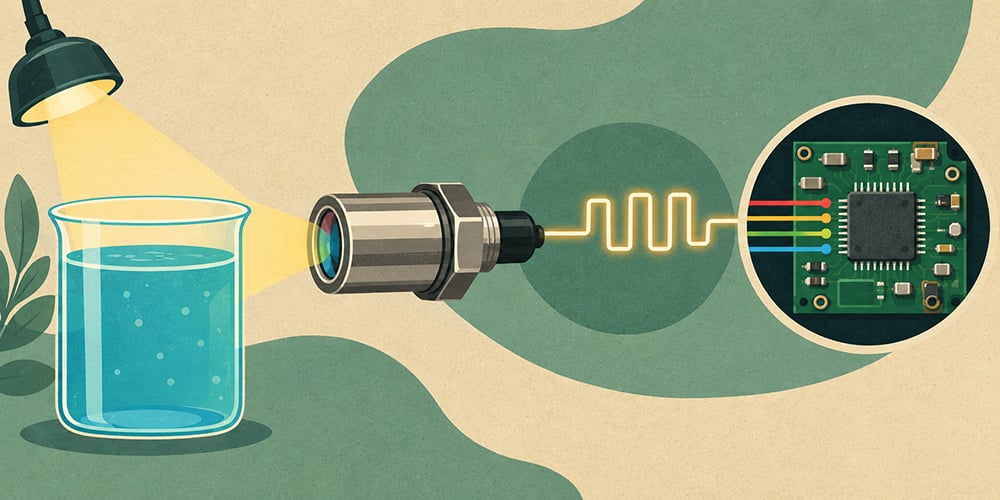
A color sensor mimics what the human eye does naturally, but it uses electronics rather than biological photoreceptors. The process has five clear sequences.
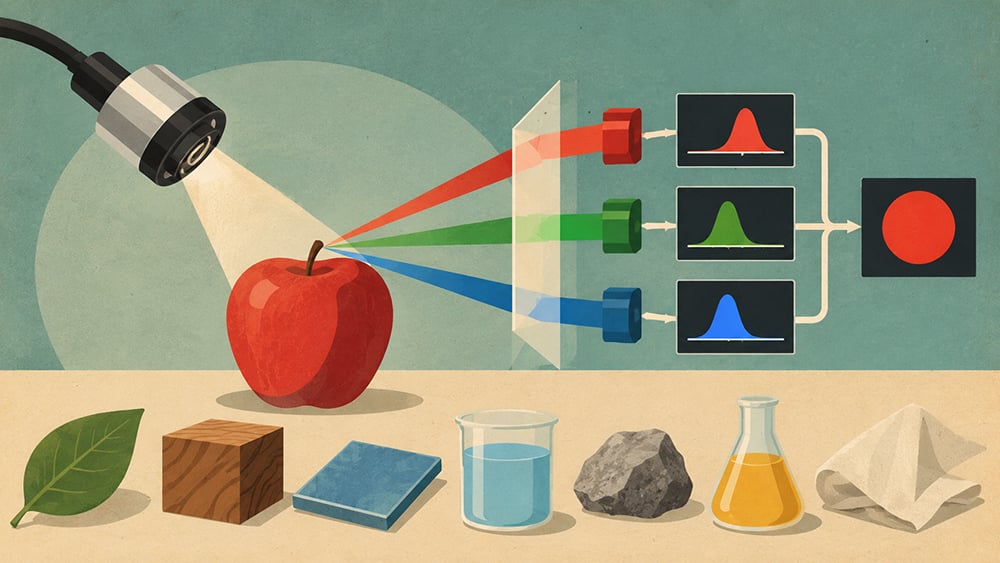
Color measurement requires a light source. Without consistent illumination, color measurements become unreliable; as ambient lighting changes, readings drift, and shadows shift. This is why most color sensors include an integrated LED light source that emits a controlled and steady beam onto the target surface. It ensures that every measurement is made under the same lighting conditions, regardless of the environment.
Once the light hits the target, some of it bounces back, and the sensor captures this reflected light through a lens or optical aperture. The distance, angle, and optical design are factors that affect how the reflected light is gathered, which is why optical sensor placement is important in real-world applications.

Inside the sensor, the reflected light passes through color filters. One for red, one for blue, and one for green. Behind each filter is a photodetector, usually a photodiode, which measures the light intensity in that specific wavelength range.
The result is three separate intensity readings. One for how much red light was reflected, one for blue, and one for green. Together, these three values define the color of the target.
The light intensity values are then converted into electrical signals and processed by the color sensor’s internal circuitry. Depending on the sensor design, the output may be analog (a voltage proportional to intensity) or digital (a binary value transmitted over a communication protocol such as I2C). The processed values are then sent to a microcontroller, data logger, or monitoring system for interpretation.
There are many formats to represent the ultimate color. In many industrial and scientific applications, color values are reported using standard color spaces, such as L*a*b*, XYZ, or, most commonly for electronic sensing, RGB (Red, Green, Blue). Each has advantages and disadvantages, but RGB is arguably the most versatile and widely understood, which is why most modern color sensors are built on it.
The human eye has three types of color-sensitive cells, called cone cells. Each is tuned to a different part of the visible spectrum. Roughly, these are red, green, and blue. This is why three channels are enough to represent the whole spectrum of colors that we see – this is the principle of trichromacy.
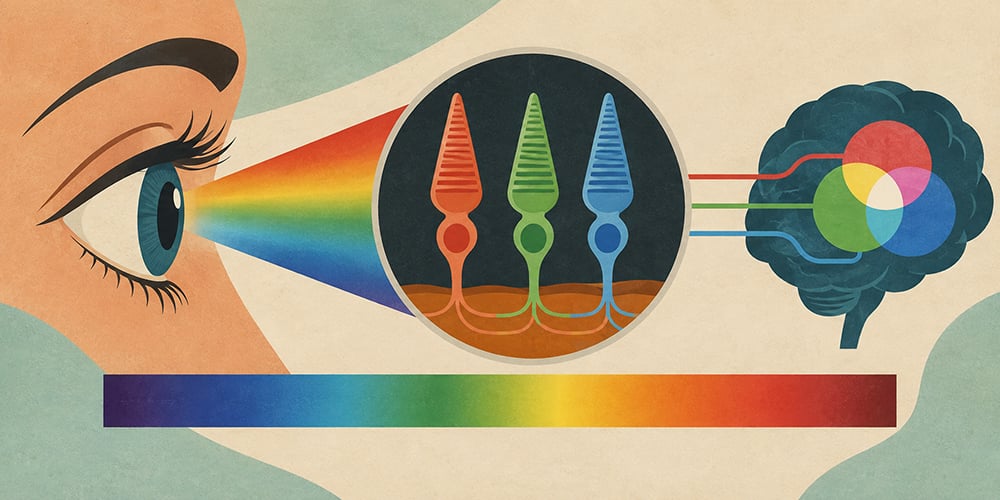
RGB color sensors are based on exactly this model. A sensor that separately measures the intensity of red, green, and blue light can mathematically reconstruct any color in the visible spectrum. Mix all three at full strength, and you get white. All three at zero, and you get black. Other combinations give other identifiable colours.
This makes RGB the best format for color sensing for most practical applications. It is easy to calculate, it is directly tied to how displays and cameras reproduce color, and it gives you three independent data points that fully characterize a color without having to do a full spectral scan across hundreds of wavelengths.
Both terms are used in color measurement, so it is worth making a distinction between the RGB sensors and the more complex spectral (or spectrometer) approach.
A spectral color sensor detects light in multiple narrow wavelength bands simultaneously – sometimes dozens or even hundreds of channels. This provides a very detailed picture of the optical properties of a sample and is ideal for scientific research, laboratory analysis, or highly complex color discrimination.
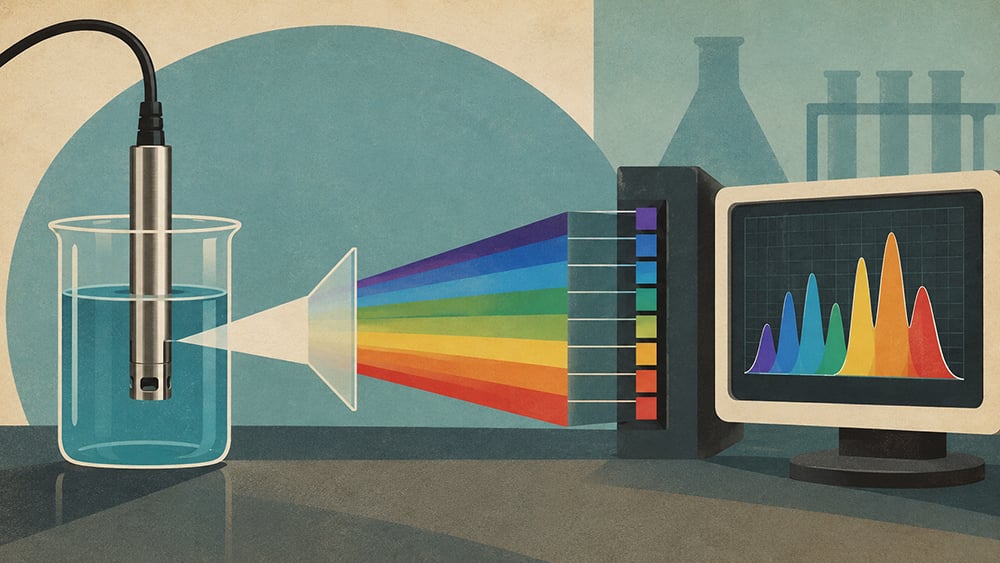
But an RGB color sensor only measures three broad channels: red, green, and blue. This is less rich, but three channels are more than enough for the vast majority of applications, monitoring the color of a liquid, verifying a product color against a reference, or detecting color change as a chemical reaction proceeds. RGB sensors are faster, smaller, consume less power, and are much more cost-effective than spectrometers. They also tend to be more easily integrated into embedded systems and IoT monitoring software devices.
If the signal is the change of color, not the exact spectral fingerprint of a material, then RGB is the right tool for the application.
Most color sensors are designed with solid objects in mind, such as packaging, textiles, plastics, or surfaces. At Atlas Scientific, we take a different approach, offering RGB color sensors purpose-built for use in liquids and aqueous solutions.
This is important as liquid color monitoring is a fundamentally different challenge. Water-based samples scatter and transmit light differently from solid surfaces. The color sensor needs to be robust against fouling, compatible with continuous immersion, and precise enough to detect subtle shifts in color that correlate with changes in water quality.
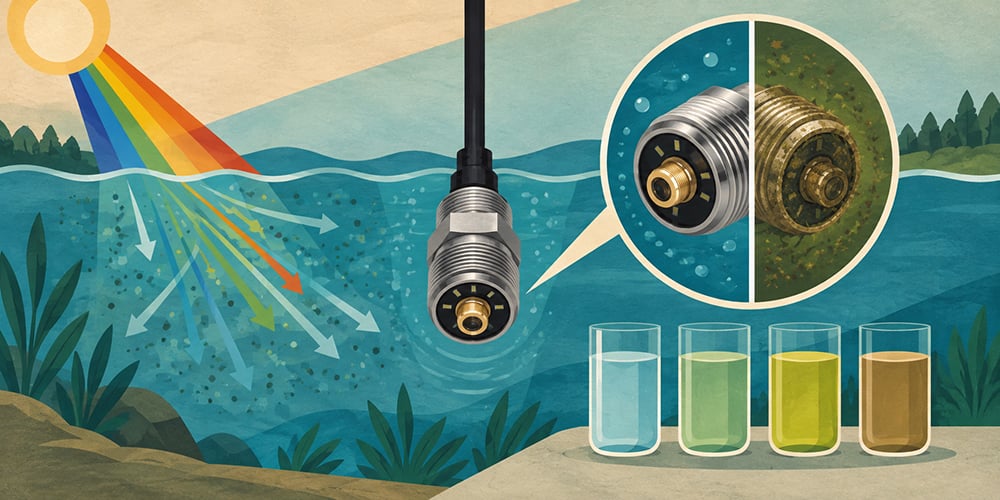
Atlas Scientific’s EZO-RGB Color Sensor is designed to address exactly that. It measures how the red, green, and blue light interact with a liquid sample, allowing changes in the liquid’s color and optical properties to be quantified digitally and reports color values that can be logged, trended, and used for a broader water quality monitoring system. The EZO-RGB Color Sensor outputs data in a format that integrates directly with microcontrollers and data systems, making it simple to build color monitoring into automated pipelines.
What sets our approach apart is the combination of scientific-grade accuracy with practical embeddability. The EZO-RGB is not a benchtop instrument; it is a sensor that has been designed to live inside a system, continuously monitoring and feeding data upstream. For applications such as industrial water quality monitoring, like wastewater management, drinking water treatment, environmental sampling, and process control in food and beverage production, this distinction is vital.

Color sensing is one of those technologies that, once you start looking for it, you find everywhere.
Color is one of the most immediate indicators of water quality. The colour of water is affected in characteristic ways by each of these: turbidity, organic loading, algal blooms, and chemical contamination. Continuous RGB color monitoring means treatment facilities and environmental monitoring stations can detect these changes on the fly, rather than waiting for lab results.
Color is often the first quality indicator in food production. From the golden color of cooking oil to the amber of a brewed beer to the consistency of a tomato paste, RGB sensors can ensure that a product complies with its color specification before it leaves the production line.

Batch-to-batch color consistency is important in chemical manufacturing, dyeing operations, and coating processes. Color sensors provide a closed-loop feedback mechanism, sensing drift and taking corrective action automatically.
Rivers, lakes, and estuaries change color with seasonal variation, pollution events, and ecological change. These shifts can be monitored remotely and continuously in aquatic environments at a scale that manual sampling simply cannot match by deploying color sensors.

Pharmaceutical and Laboratory Applications
Colorimetric assays are one of the many analytical techniques that detect a change in color as a measure of concentration or the progress of a reaction. RGB sensors can automate and digitize this type of measurement by connecting the color sensor to a Raspberry Pi, improving throughput and reducing human error.
Getting reliable readings from a color sensor is not just about selecting the right hardware, but also about how the sensor is deployed and maintained.
Accurate color measurement is based on Consistent Illumination. Any changes in ambient light, changes in the LED output over time, or partial obstruction of the light path will all create an error. Sensors with built-in light sources and reference channels compensate for this automatically.
Distance and Geometry are important because the amount of reflected light collected depends on the angle and distance between the sensor and target. Most sensors will specify an optimal working distance, and moving either too far away or too close will reduce the accuracy.
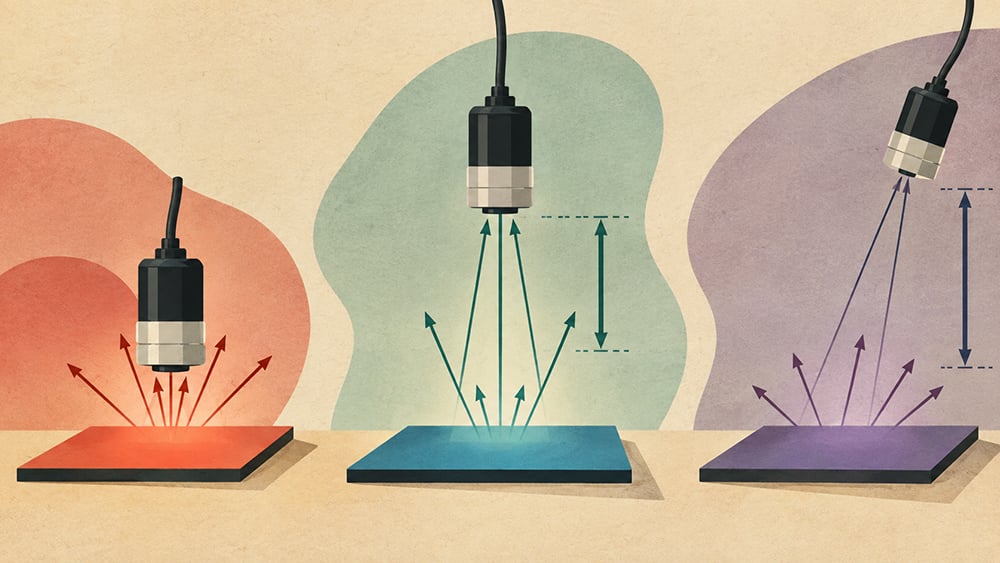
Calibration is needed for long-term stability. A properly calibrated sensor measures against known reference values. EZO-RGB from Atlas Scientific has a calibration process to ensure sensor accuracy over time in even the harshest environments.
Sample or Surface Properties affect the interaction of light with the target. Very shiny surfaces can create specular reflections that alter readings. In liquid applications, turbidity, bubbles, or particulates can scatter light in unpredictable ways. Successful use of a color sensor requires an understanding of these factors.
Color sensors convert one of the most basic properties of light into something actionable. An RGB color sensor can split reflected light into red, green and blue components and measure the intensity of each, characterizing the color of almost any target, solid or liquid, with speed, consistency and accuracy that the human eye simply can’t match at scale.
The use of RGB color sensing, especially in liquid monitoring applications, offers a continuous, real-time look at processes that have traditionally been sampled manually and analyzed in a laboratory setting. That’s what Atlas Scientific’s RGB color sensors are built for: taking scientific-grade color measurement out of the lab and into the field, the process line, and the monitoring network.
If you have questions about using an RGB color sensor in your system, or would like to know which Atlas Scientific sensor is right for your application, please contact the team at Atlas Scientific. We’re here to help.
Conductivity is one of the most important measurements in industrial water systems. From water treatment and hydroponics to chemical processing and manufacturing, conductivity provides a

When a process requires more than one chemical, nutrient, reagent, or additive, using several independent dosing pumps can quickly become complicated. A multi-pump dosing system