

Blog
The Best Indoor Air Quality Monitors
Indoor air quality can have a major impact on the comfort and productivity of homes, offices, schools, laboratories, and industrial facilities. Carbon dioxide buildup, poor




Color sensors allow machines to do something humans take for granted: identify and distinguish colors. From automated sorting and quality control to robotics, product identification, lighting systems, and scientific instrumentation, a reliable color sensor can turn reflected light into usable digital data.
But not all color sensors are designed for the same job.
Many popular RGB sensors are inexpensive ICs or development boards intended to be incorporated into a larger electronic system. They can be excellent choices for prototyping, but using one in a finished machine may require additional illumination, mechanical protection, mounting hardware, software, and environmental protection.
The Atlas Scientific EZO-RGB™ Embedded Color Sensor takes a different approach. Instead of providing developers with only a sensor IC or exposed breakout board, Atlas Scientific packages the sensing system into a rugged, ready-to-integrate device.
In this comparison, we’ll look at the Atlas Scientific EZO-RGB, Adafruit TCS34725, DFRobot TCS34725, and Vishay VEML6040 to see where each solution fits, and why the EZO-RGB is particularly compelling for equipment builders and applications that need more than a bare sensor.
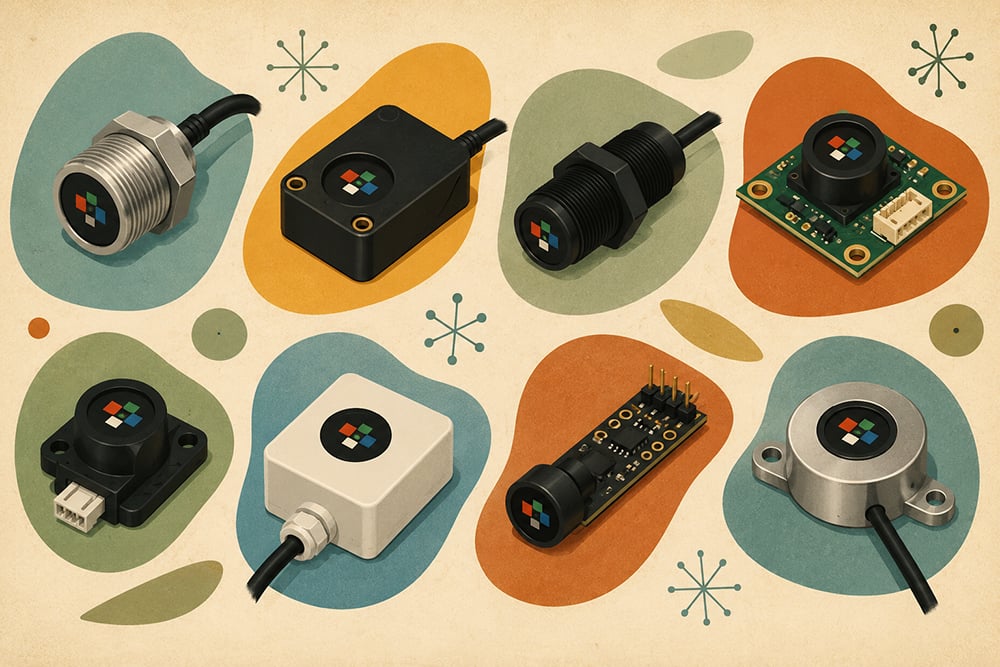
A color sensor measures light at different wavelengths, generally corresponding to red, green, and blue portions of the visible spectrum.
These measurements can then be used to identify or compare colors.
Depending on the sensor, the device may provide raw RGB measurements or calculate additional information such as illuminance, color temperature, or standardized color coordinates.
The challenge is that the sensing element is only part of a complete color measurement system.
Lighting conditions, sensor distance, viewing angle, mechanical positioning, environmental exposure, and software processing can all affect the final measurement.
That distinction becomes important when comparing the Atlas Scientific EZO-RGB with conventional breakout boards and sensor ICs.
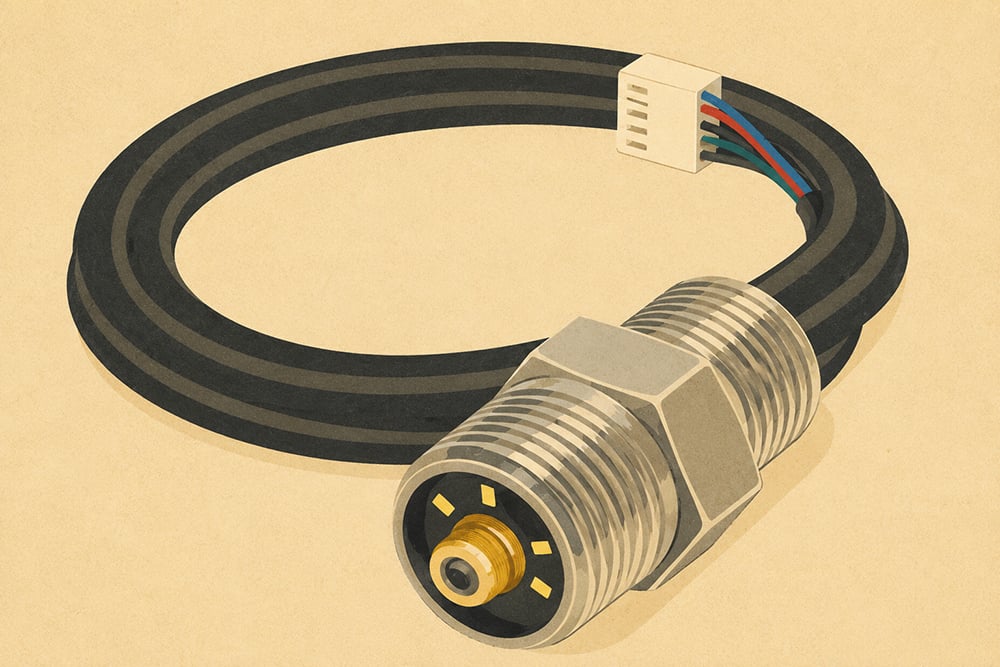
The Atlas Scientific EZO-RGB™ is designed as a complete embedded color-sensing solution rather than simply an exposed sensor board.
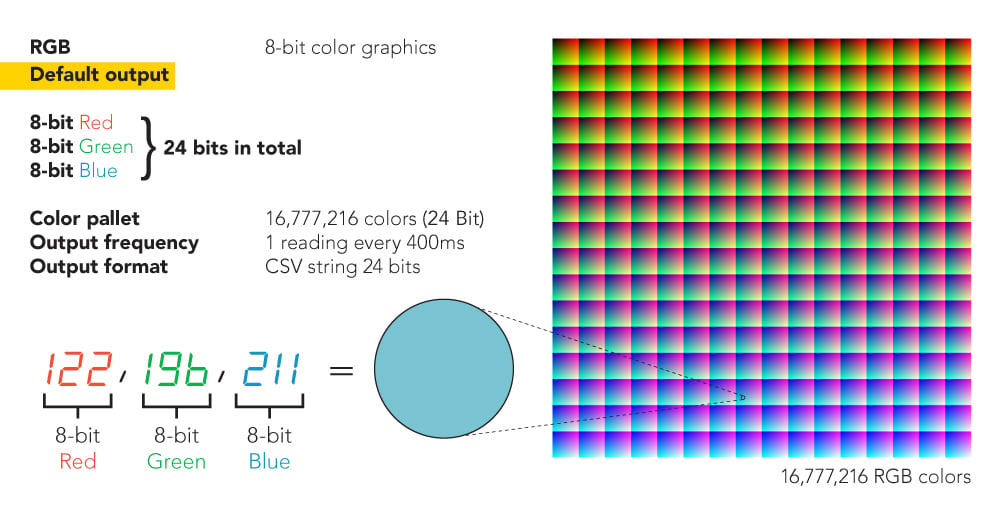
The stainless-steel version uses a 316 stainless-steel body and carries an IP67 water- and dust-resistance rating. Atlas specifies that it can read 24-bit RGB, CIE xyY, and LUX from 0–65,535.
It also incorporates six white illumination LEDs, eliminating one of the major headaches associated with designing a repeatable color-sensing system: providing controlled illumination. The Atlas datasheet specifies illumination of up to approximately 40,000 lux at 5 V.
Key specifications
Atlas Scientific also provides Arduino and Raspberry Pi sample code, UART and I²C libraries, PC monitoring software, and a downloadable 3D STEP model for mechanical integration.
That combination is where the EZO-RGB begins separating itself from conventional development-board color sensors.
The Adafruit TCS34725 has long been a popular color-sensing breakout board for Arduino and other electronics projects.
The TCS34725 incorporates RGB and clear-light sensing elements with an IR-blocking filter. Adafruit’s breakout also includes a neutral white LED to illuminate the target and supporting circuitry that allows operation from 3–5 V.
The underlying sensor offers an impressive dynamic range, adjustable integration time, and adjustable gain.
Through Adafruit’s software library, developers can retrieve raw RGBC values, 8-bit RGB values, calculated lux, and estimated color temperature.
For breadboard prototyping, hobby electronics, education, and compact embedded projects, it is an excellent little sensor.
There is an important catch for someone selecting a component for a new product, however: Adafruit currently lists this particular TCS34725 breakout as discontinued/no longer stocked and recommends its APDS9960 board instead.
It is also fundamentally an exposed circuit board rather than an enclosed industrial-style sensor assembly.
DFRobot offers another implementation of the popular TCS34725.
Its Gravity TCS34725 provides RGB measurements through an I²C interface and incorporates an IR-blocking filter. DFRobot also includes four onboard LEDs, allowing the sensor to illuminate a target rather than relying entirely on ambient lighting.
DFRobot specifies:
Like the Adafruit solution, its biggest advantage is accessibility. It is inexpensive and easy to connect to Arduino-style systems.
But again, the product is an exposed PCB module.
For a prototype sitting on a workbench, that’s perfectly reasonable. For a sensor mounted permanently into a piece of equipment, additional mechanical and environmental design may be required.
The Vishay VEML6040 approaches color sensing at an even lower component level.
Rather than being a development board or finished sensor assembly, the VEML6040 is a tiny surface-mount RGBW color-sensor IC measuring only 2.0 × 1.25 × 1.0 mm.
It measures red, green, blue, and white channels at 16-bit resolution per channel, communicates over I²C, and incorporates Vishay’s Filtron™ technology to provide spectral sensitivity designed to approximate human-eye response.
It is an impressive solution when you’re designing your own PCB and want color sensing integrated directly into the electronics.
But that flexibility comes with substantially more engineering responsibility.
The system designer must handle PCB integration, illumination, mechanical positioning, housing, environmental protection, connectors, wiring, and higher-level processing.
Vishay’s current datasheet also marks the VEML6040 “Not for New Designs” and identifies the VEML3328 as the alternative device.
| Feature | Atlas Scientific EZO-RGB-S | Adafruit TCS34725 | DFRobot TCS34725 | Vishay VEML6040 |
|---|---|---|---|---|
| Sensor Type | Complete embedded sensor | Breakout board | Breakout board | Surface-mount IC |
| RGB Measurement | 24-bit RGB | RGB/RGBC | RGB | RGBW |
| CIE xyY Output | Yes | Not native output | Not listed as native output | Not native output |
| LUX | 0–65,535 | Library-calculated | Primarily RGB | Up to 16,496 lux selectable range |
| Built-In Illumination | 6 white LEDs | 1 white LED | 4 LEDs | No |
| Communication | UART + I²C | I²C | I²C | I²C |
| Human-Readable ASCII Output | Yes | No | No | No |
| Programmable Color Matching | Yes | Software required | Software required | Software required |
| Operating Voltage | 3.3–5 V | 3–5 V breakout | 3.3–5 V | 2.5–3.6 V |
| Protective Housing | 316 stainless steel | None | None | None |
| Water/Dust Protection | IP67 | None specified | None specified | Requires product enclosure |
| Integrated Cable | 1 meter | No | Short board connection | No |
| Mechanical Mounting | Integrated threaded body / locknut | PCB mounting | PCB mounting | PCB integration |
| Arduino Friendly | Yes | Yes | Yes | Requires additional integration |
| Raspberry Pi Friendly | Yes | Yes | Yes | Requires additional integration |
| Best Application | Equipment, embedded systems, rugged installations & automation | Prototyping | Prototyping & robotics | Custom PCB design |
The comparison becomes much clearer when you stop looking at the products simply as “RGB sensors.”

They aren’t really competing at exactly the same level.
The Adafruit and DFRobot products are primarily development boards.
The Vishay device is a sensor IC.
The Atlas Scientific EZO-RGB is much closer to a finished sensing instrument designed to become part of another machine.
That distinction produces several important advantages.
An exposed PCB is easy to prototype with but isn’t always what you want mounted to production equipment.
The stainless-steel EZO-RGB puts the electronics inside a 316 stainless-steel housing with an IP67 rating.
Instead of designing a housing around your color sensor, much of that mechanical engineering has already been done.
Color measurement is highly dependent on lighting.
Change the illumination and the measured color can change with it.
The EZO-RGB incorporates six white LEDs directly around the sensing area, providing a controlled light source at the point of measurement.
DFRobot and Adafruit also provide onboard illumination, which is an advantage over a bare IC. However, Atlas packages its illumination together with the sensing electronics inside the finished sensor assembly.
For repeatable machine installations, that is a major practical advantage.
A basic color sensor can give you red, green, and blue values.
The EZO-RGB goes further by directly supporting:
That can reduce the amount of processing developers need to build themselves.
Most small color sensors communicate through I²C.
Atlas supports both UART and I²C.
That additional communication option can make integration easier in systems where UART is already available or preferable.
One of the more understated EZO-RGB advantages is its ASCII data format.
Instead of forcing every developer to work directly with low-level sensor registers, the EZO architecture is designed around straightforward commands and readable output.
That can make development, troubleshooting, and system integration considerably easier.
Being the strongest overall solution doesn’t mean the EZO-RGB should replace every inexpensive color sensor.
If you’re building a $20 Arduino experiment, an inexpensive breakout board makes more sense.
If you’re designing a high-volume consumer PCB where every millimeter and every dollar matters, a tiny surface-mount IC may be the better engineering decision.
But those aren’t necessarily the applications the EZO-RGB is trying to win.
The real question is:
What happens when the prototype needs to become a finished machine?
At that point, the cost of the sensor itself becomes only one part of the equation.
You may need to add a housing, illumination system, connector, cable, mounting solution, environmental sealing, software processing, and additional development time.
That’s where the Atlas Scientific approach becomes particularly attractive.
If your only priority is finding the cheapest way to detect RGB values on a breadboard, there are less expensive options.
But if you’re looking for a complete, rugged, ready-to-integrate color sensing system, the Atlas Scientific EZO-RGB™ Embedded Color Sensor is the clear winner in this comparison.
It combines:
into one sensor.
Competitors such as the TCS34725 and VEML6040 demonstrate how capable modern color-sensing technology can be. But they’re primarily building blocks.
The Atlas Scientific EZO-RGB is the finished tool.
For equipment manufacturers, automation projects, robotics, research systems, sorting equipment, process monitoring, and other applications where the color sensor needs to become a permanent part of the machine rather than remain an exposed development board, that difference matters.
The EZO-RGB doesn’t win because it’s the cheapest color sensor.
It wins because Atlas Scientific has already done much of the engineering required to turn a color-sensing chip into a practical, rugged, machine-ready sensor.
Indoor air quality can have a major impact on the comfort and productivity of homes, offices, schools, laboratories, and industrial facilities. Carbon dioxide buildup, poor

UART and I2C are serial communication protocols, but they serve different purposes. UART is typically used for direct device-to-device communication and requires dedicated connections. I2C