

Blog
The Best Industrial Conductivity Transmitters
Conductivity is one of the most important measurements in industrial water systems. From water treatment and hydroponics to chemical processing and manufacturing, conductivity provides a




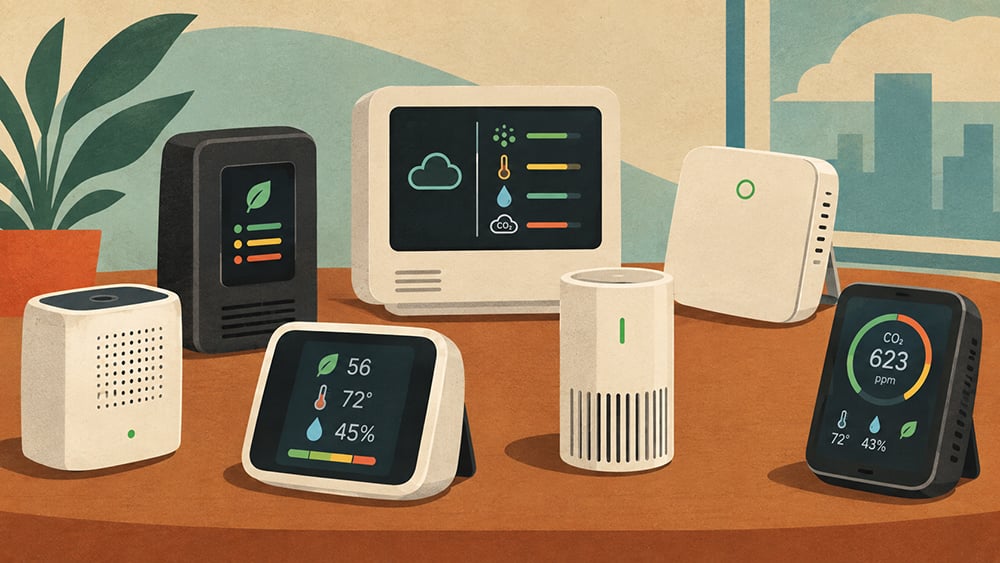
Indoor air quality can have a major impact on the comfort and productivity of homes, offices, schools, laboratories, and industrial facilities. Carbon dioxide buildup, poor ventilation, temperature fluctuations, and improper humidity levels can all indicate that an indoor environment needs attention.
That has led to a rapidly growing selection of indoor air quality monitors. Some pack in as many sensors as possible, while others concentrate on a smaller group of measurements and prioritize straightforward, reliable monitoring.
For users who want accurate CO₂, temperature, and humidity measurements without an unnecessarily complicated ecosystem, the Atlas Scientific IAQ-M Indoor Air Quality Monitor stands out as our top choice.
In this comparison, we’ll look at the Atlas Scientific IAQ-M, Airthings View Plus, IQAir AirVisual Pro, and Temtop M2000 2nd to see where each monitor excels.
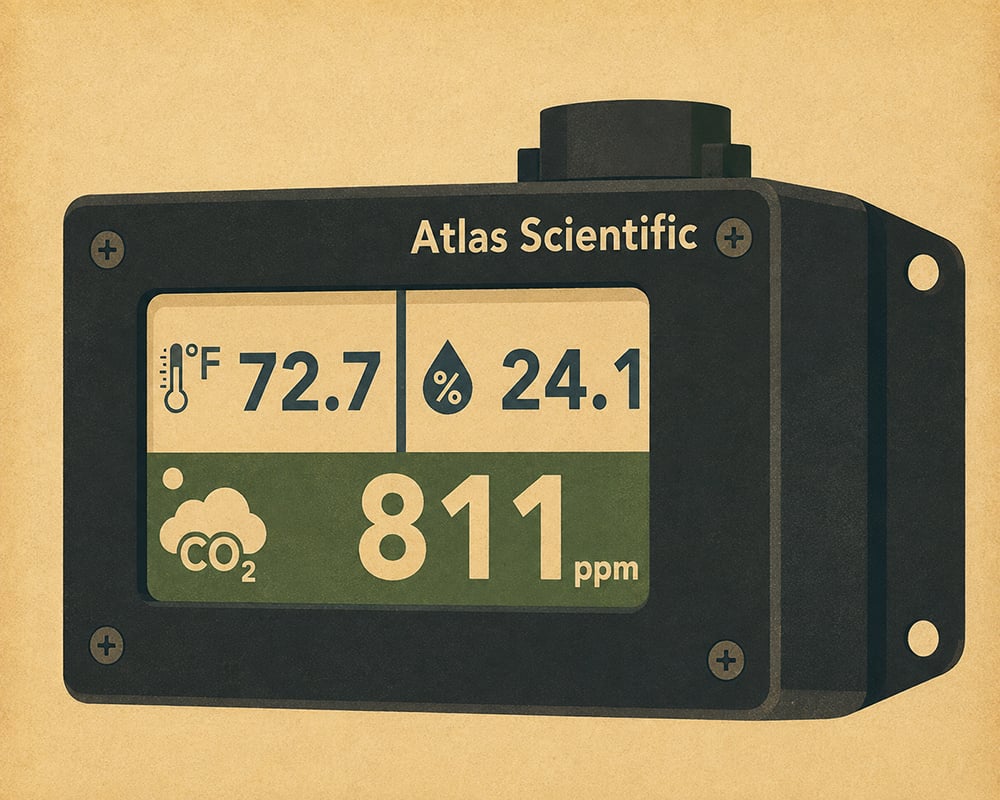
The Atlas Scientific IAQ-M Indoor Air Quality Monitor takes a refreshingly straightforward approach to air-quality monitoring.
Rather than loading the device with sensors that may not be necessary for every application, the IAQ-M concentrates on three measurements that are extremely useful when evaluating indoor environmental conditions:
All three measurements are displayed in real time. The monitor can be placed on a tabletop or wall-mounted, making it suitable for offices, classrooms, laboratories, manufacturing facilities, workshops, and residential environments.
The biggest differentiator isn’t simply what the IAQ-M measures.
It’s what you can do with the measurements.
The IAQ-M connects to Wi-Fi and can upload its readings to ThingSpeak or an MQTT service selected by the user. That opens the door to data logging, dashboards, remote monitoring, alerts, building automation, custom IoT applications, and integration with other equipment.
That flexibility is especially valuable for engineers and developers.
Instead of being locked primarily into a manufacturer’s consumer app, users can incorporate IAQ-M measurements into their own infrastructure.
For example, an IAQ-M could potentially become part of a larger system that monitors multiple rooms and uses elevated CO₂ readings as an input for ventilation or automation decisions.
The IAQ-M does not measure particulate matter, VOCs, or radon.
If detecting those specific pollutants is your primary objective, another monitor may be more appropriate.
But for users primarily interested in ventilation, CO₂, temperature, humidity, data logging, and automation, that simplicity can actually be an advantage.
Best overall choice for developers, laboratories, offices, classrooms, facilities, and custom monitoring applications.

The Airthings View Plus takes almost the opposite approach.
It incorporates seven measurements:
Radon, PM2.5, CO₂, VOCs, humidity, temperature, and atmospheric pressure.
That’s impressive.
Its CO₂ sensor uses NDIR technology with a specified range of 400–5,000 ppm, while its PM2.5 sensor uses laser scattering and measures concentrations from 0–1,000 µg/m³.
The View Plus also offers Wi-Fi, an e-paper display, the Airthings mobile app, notifications, and integrations with platforms including IFTTT, Amazon Alexa, and Google Assistant.
The View Plus is arguably the stronger choice when the objective is measuring as many indoor pollutants as possible in one consumer-friendly device.
But that’s not necessarily what engineers and system integrators need.
Airthings emphasizes its own app, dashboard, smart-home integrations, and ecosystem. Atlas Scientific instead explicitly provides MQTT and ThingSpeak connectivity, making the IAQ-M particularly attractive when measurements need to become part of a custom monitoring or automation system.
Winner for sensor variety: Airthings
Winner for custom integration: Atlas Scientific
IQAir is well known in the air-quality industry, and the AirVisual Pro combines particulate monitoring with CO₂ and environmental measurements.
According to IQAir’s specifications, the AirVisual Pro monitors PM2.5, CO₂, temperature, and humidity. Its CO₂ measurement range extends from 400–10,000 ppm.
A major advantage is its large 5-inch display, which makes it easy to visualize air-quality conditions.
It also includes Wi-Fi connectivity and a rechargeable battery.
The AirVisual Pro makes sense when particulate pollution is the central concern.
For engineering and automation applications, however, the Atlas approach is more flexible. The IAQ-M’s explicit support for MQTT allows measurements to be sent to a user-selected service rather than simply serving as a standalone air-quality display.
That distinction becomes important when deploying air-quality monitors as components within a larger IoT system.
Winner for PM2.5 visualization: IQAir
Winner for integration and automation: Atlas Scientific
The Temtop M2000 2nd is different from the other monitors in this comparison because portability is one of its biggest strengths.
The unit measures CO₂, PM2.5, PM10, formaldehyde, temperature, and humidity.
Its CO₂ sensor uses NDIR technology and has a measurement range of 0–5,000 ppm, while its laser PM2.5 sensor covers 0–999 µg/m³.
A rechargeable 3,000 mAh battery provides roughly 6–8 hours of operation, making the device useful for moving between rooms and conducting spot measurements.
These products are really aimed at different applications.
The Temtop makes sense when someone needs to walk around a building and investigate different spaces.
The Atlas Scientific IAQ-M is better suited to becoming a permanent monitoring node.
Its wall/tabletop installation, continuous USB power, Wi-Fi connectivity, and MQTT/ThingSpeak support make much more sense for continuously logging environmental conditions or incorporating air-quality measurements into automation infrastructure.
Winner for portable measurements: Temtop
Winner for permanent connected monitoring: Atlas Scientific
| Feature | Atlas Scientific IAQ-M | Airthings View Plus | IQAir AirVisual Pro | Temtop M2000 2nd |
| CO₂ | Yes | Yes | Yes | Yes |
| Temperature | Yes | Yes | Yes | Yes |
| Humidity | Yes | Yes | Yes | Yes |
| PM2.5 | No | Yes | Yes | Yes |
| PM10 | No | No | No | Yes |
| VOC | No | Yes | No | No |
| Radon | No | Yes | No | No |
| Formaldehyde | No | No | No | Yes |
| Real-Time Display | Yes | Yes | Yes | Yes |
| Wi-Fi | Yes | Yes | Yes | No* |
| MQTT Support | Yes | Not a primary feature | Not a primary feature | No |
| ThingSpeak Support | Yes | No | No | No |
| User-Selectable Data Platform | Excellent | Limited ecosystem | IQAir ecosystem | Primarily local/data export |
| Mounting | Wall or tabletop | Wall or tabletop | Tabletop | Handheld |
| Power | USB | AA batteries / USB-C | Rechargeable battery | Rechargeable battery |
| Best For | Developers, automation, labs, offices & custom monitoring | Smart homes & broad pollutant monitoring | Consumer PM/CO₂ monitoring | Portable spot measurements |

The Atlas Scientific monitor doesn’t try to win by having the longest sensor list. Instead, it focuses on three fundamental indoor environmental measurements, CO₂, temperature, and humidity, and makes that data unusually easy to use in external monitoring and automation systems. Atlas Scientific specifically supports Wi-Fi uploads to ThingSpeak or an MQTT service of your choice, giving it a significant advantage for users building their own monitoring infrastructure.
At first glance, it would be easy to assume that the indoor air-quality monitor with the most sensors automatically wins.
But sensor count isn’t everything.
The better question is:
What information do you actually need, and what do you want to do with that information?
For many indoor environments, CO₂ is particularly useful for understanding ventilation conditions. Combine that measurement with temperature and relative humidity and you have three important parameters for continuously monitoring indoor environmental conditions.
Atlas Scientific keeps the system focused on exactly those measurements.
Then it adds something particularly useful:
Open-ended connectivity.
The IAQ-M can send readings over Wi-Fi to ThingSpeak or an MQTT service of your choice.
For an engineer, developer, researcher, facility operator, or IoT enthusiast, that can be more valuable than another proprietary smartphone dashboard.
You can build your own dashboard.
You can log long-term measurements.
You can incorporate measurements into an IoT platform.
You can create alerts.
And you can potentially use those measurements as inputs within a larger automation system.
That’s what separates the IAQ-M from many consumer-oriented air-quality monitors.
Choose the Airthings View Plus if you want the broadest range of measurements, particularly radon, PM2.5, and VOC monitoring.
Choose the IQAir AirVisual Pro if particulate matter monitoring and an easy-to-read display are high priorities.
Choose the Temtop M2000 2nd if you need a portable instrument for taking measurements throughout different locations.
But choose the Atlas Scientific IAQ-M if you want a straightforward, permanently installed monitor that combines CO₂, temperature, humidity, Wi-Fi connectivity, and unusually flexible data integration.
Every monitor in this comparison has a legitimate strength.
The Airthings View Plus wins on the number of environmental parameters measured. The IQAir AirVisual Pro adds strong particulate monitoring and visualization. The Temtop M2000 2nd is particularly useful as a portable measurement instrument.
But the Atlas Scientific IAQ-M offers the strongest combination of simplicity, continuous monitoring, connectivity, and integration flexibility for users who need CO₂, temperature, and humidity data.
Rather than forcing users into a complicated system, Atlas Scientific gives them the essential measurements and provides the tools to put that data to work.
Overall Winner: Atlas Scientific IAQ-M
Best for: IoT projects, building monitoring, offices, schools, laboratories, workshops, automation systems, and users who want control over their environmental data.
For users who want an indoor air quality monitor that is simple, accurate, connected, and ready to become part of a larger monitoring system, the Atlas Scientific IAQ-M is our top pick.
Conductivity is one of the most important measurements in industrial water systems. From water treatment and hydroponics to chemical processing and manufacturing, conductivity provides a

When a process requires more than one chemical, nutrient, reagent, or additive, using several independent dosing pumps can quickly become complicated. A multi-pump dosing system