

Blog
The Best Indoor Air Quality Monitors
Indoor air quality can have a major impact on the comfort and productivity of homes, offices, schools, laboratories, and industrial facilities. Carbon dioxide buildup, poor





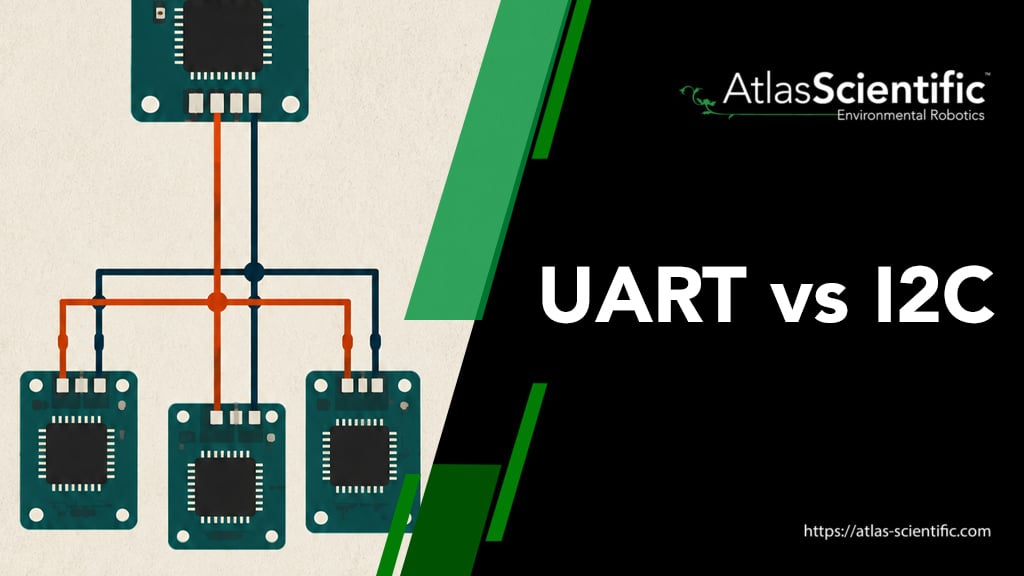
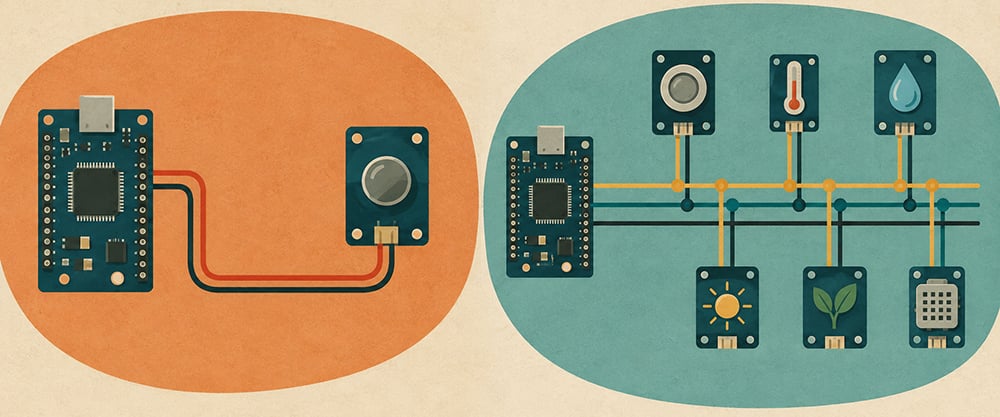
UART and I2C are serial communication protocols, but they serve different purposes. UART is typically used for direct device-to-device communication and requires dedicated connections. I2C uses just two shared wires, allowing multiple sensors and peripherals to communicate with a single microcontroller on the same bus.
UART and I2C are some of the most common communication protocols used in embedded systems and sensor-based projects. UART (Universal Asynchronous Receiver/Transmitter) is a simple, point-to-point method for connecting two devices directly without the need for a clock signal. I2C (Inter-Integrated Circuit) is a synchronous bus protocol that allows one master to communicate with multiple slave devices using only two wires. Both are for low-speed serial data transfer, but they operate very differently, and picking the wrong one for your project can lead to real headaches down the road.
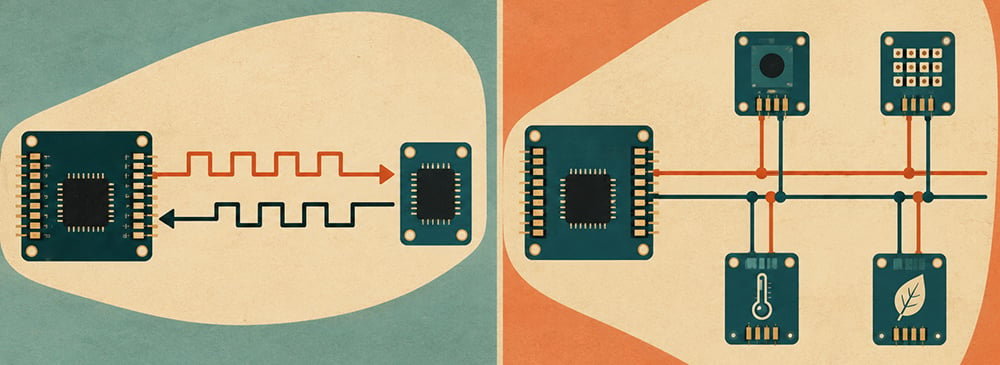
Comparative reviews of embedded communication interfaces have shown that UART, I²C, and SPI each offer different trade-offs in terms of complexity, scalability, and performance depending on the application.
Understanding the distinction between UART and I2C can help you develop more intelligent and dependable systems, whether you’re creating a water quality monitoring system, a hydroponic controller, or any other sensor-based system.
UART stands for Universal Asynchronous Receiver/Transmitter. Despite the name, UART is primarily a hardware communication interface that implements a standardized asynchronous serial framing method. What makes UART unique is that it is asynchronous, meaning there is no shared clock signal between the two communicating devices.
Instead of relying on a clock, UART uses a pre-agreed baud rate, a measure of how many bits per second are transmitted. Both the sending and receiving devices must be configured to the same baud rate before communication begins. UART devices require closely matched baud rates, typically within a few percent.
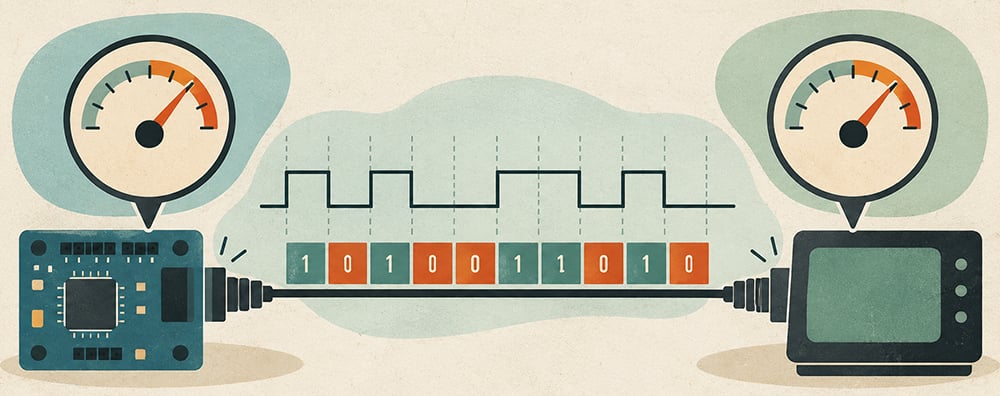
UART uses two wires:
Each piece of data is sent as a packet, which includes a start bit, a data frame (typically 8 bits), an optional parity bit for basic error checking, and one or two stop bits. Communication is strictly point-to-point: one device talks to one other device.
NOTE: A functioning UART connection almost always requires a shared ground (GND) in addition to TX and RX.
UART is commonly found in:
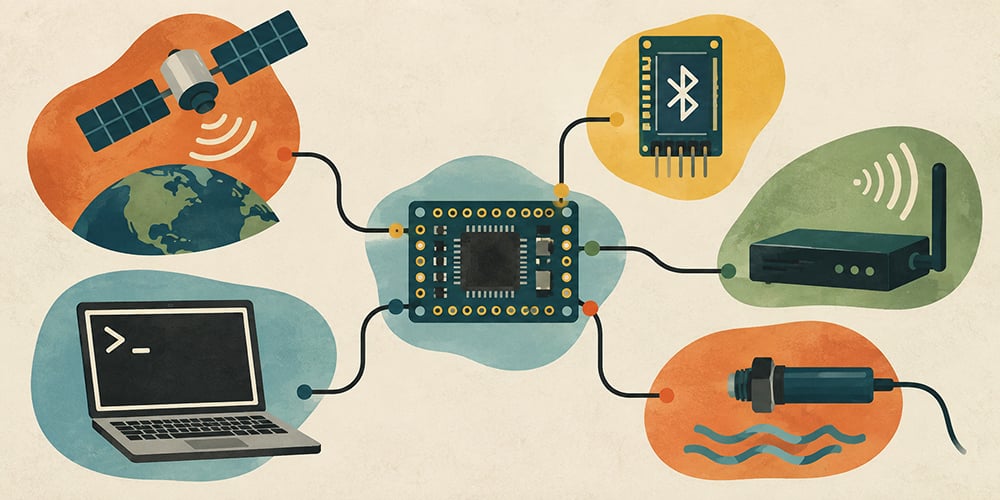
NOTE: Several Atlas Scientific sensors support UART mode, allowing direct serial communication with microcontrollers. This makes wiring straightforward and setup fast, particularly in single-sensor applications.
I2C (Inter-Integrated Circuit, sometimes written IIC) is a synchronous communication protocol developed by Philips Semiconductors in 1982. Unlike UART, I2C uses a shared clock signal generated by the master, which keeps all devices on the bus synchronized.
I2C also uses just two wires:
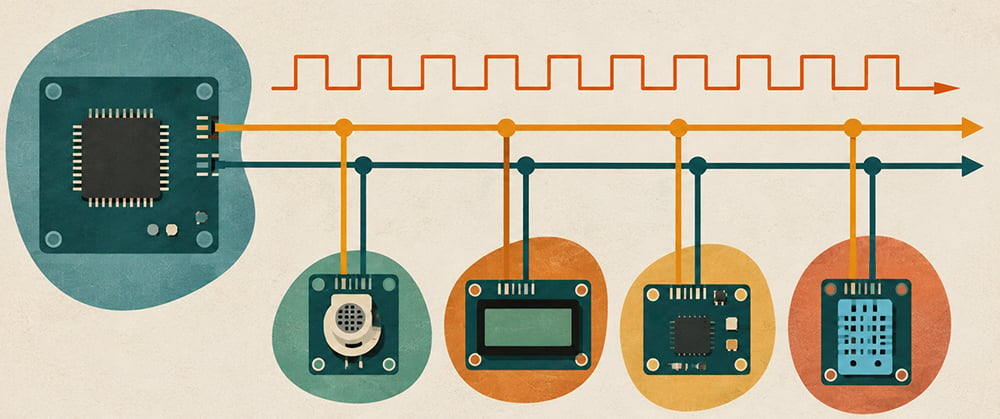
The real power of I2C lies in its master/slave architecture. Most I2C systems use a single master, although the protocol supports multiple masters. Multiple slave devices (sensors, displays, EEPROMs, and more) share the same two-wire bus, each identified by a unique 7-bit address. A 7-bit address space provides up to 128 address values, though many are reserved and practical device counts are usually far lower.
Both SDA and SCL lines require pull-up resistors to function correctly. Many breakout boards and sensor modules include these resistors built in, so you often don’t need to add them yourself.
I2C is commonly found in:
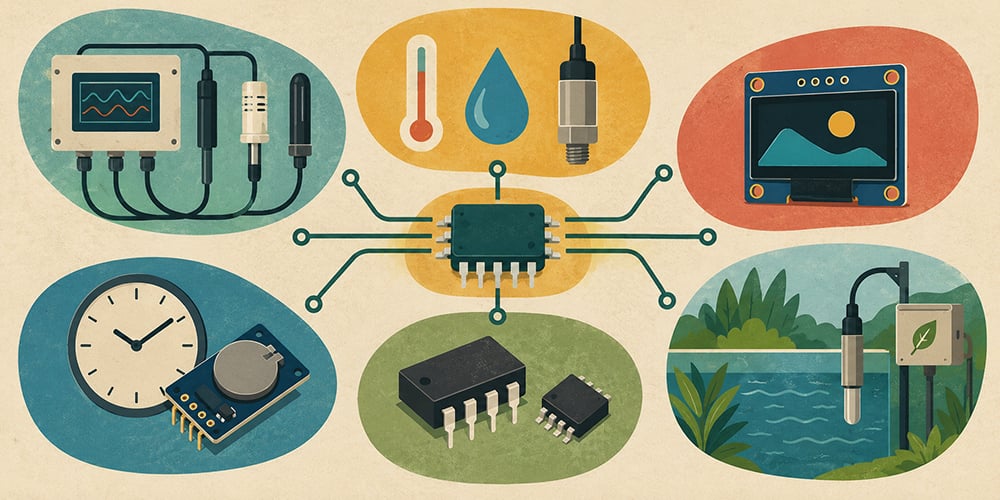
NOTE: Atlas Scientific sensors are also available in I2C mode, making it straightforward to connect multiple sensors, such as a pH probe, dissolved oxygen sensor, and EC meter, to a single microcontroller with minimal wiring.
| Feature | UART | I2C |
| Synchronisation | Asynchronous (no clock) | Synchronous (shared clock) |
| Wires Required | 2 (TX, RX) plus GND | 2 (SDA, SCL) plus GND |
| Number of Devices | Point-to-point by default | Multiple addressed devices on one bus |
| Typical Speed | 9.6 kbps–115.2 kbps | 100 kbps (standard), up to 3.4 Mbps |
| Addressing | None | 7-bit address per device |
| Error Checking | Optional parity | ACK/NACK acknowledgement, arbitration |
| Pull-up Resistors | Not required | Required on SDA and SCL |
| Duplex | Full-duplex | Half-duplex |
| Complexity | Very simple | Moderate |
| Best For | Single sensor, simple serial comms | Multi-sensor systems, scalable designs |
For almost any real-world embedded and sensor application, neither UART nor I2C is going to be your bottleneck. Either protocol is more than fast enough for reading sensor values.
It is worth noting that in many sensor applications, I2C is commonly operated at higher speeds than the UART settings typically used for device communication. Standard I2C is rated at 100kbps, fast mode is rated at 400kbps, and high speed mode is rated at 3.4Mbps. While many UART applications run between 9.6 kbps and 115.2 kbps, modern UART peripherals often support speeds of 1 Mbps or more, so I2C is not necessarily faster in every system.
For measurements that are slowly changing, like temperature in a lake, or pH, or dissolved oxygen, this difference is hardly relevant, but if you are making a system where you want to poll hundreds of sensors with minimum delay and process the data in near real time, I2C provides you with more headroom.
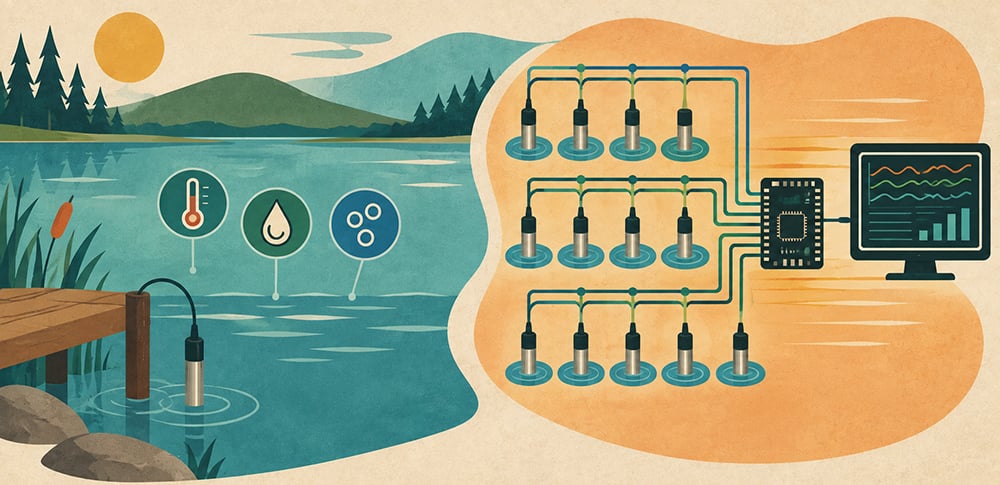
On paper, they’re both two wires, so you might think they’re just as easy to wire up. In reality, they differ. UART is very easy to wire up. No pull-up resistors required, no address to set, no bus to manage. Simply wire TX to RX (and RX to TX), select a baud rate, and you’re done.
I2C requires pull-up resistors on the SDA and SCL lines, and each device on the bus must have a unique I2C address. If two sensors share the same default address (which is common with readily available sensors) you will need to change the address of one device or use an I2C multiplexer. Atlas Scientific EZO™ circuits allow their I2C addresses to be changed in software, while some third-party devices may require hardware address pins or jumpers to change their addresses, or a multiplexer if their addresses cannot be changed.
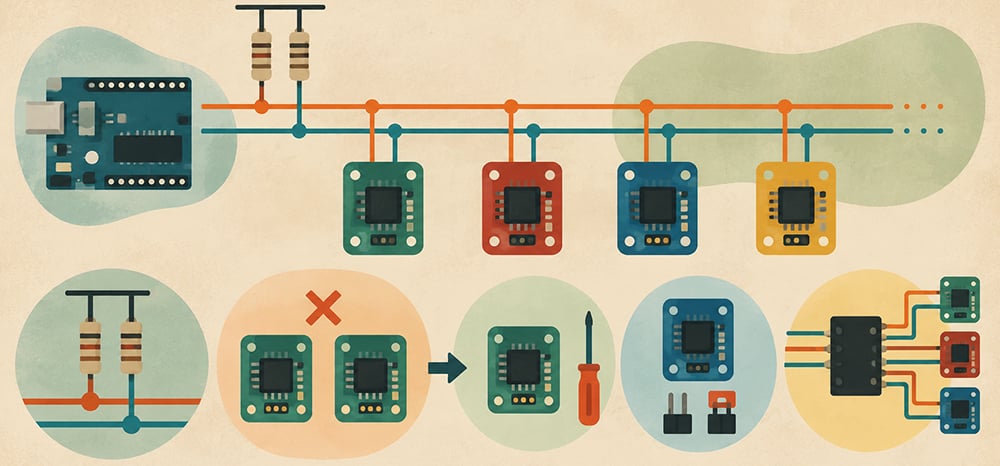
The benefit here is that after you have successfully set up your I2C bus, adding another sensor becomes as simple as daisy-chaining them along. In contrast, to add another sensor to your UART system, you’ll need to take up two more hardware ports on your microcontroller.
This is often the deciding factor between UART and I2C.
If you only need one sensor, UART is hard to beat for its simplicity. Connect it, configure the baud rate, and start reading data. There’s almost nothing that can go wrong.
If you need multiple sensors, I2C is almost always the better choice. Sharing a single two-wire bus between many devices keeps your wiring clean, saves microcontroller pins, and scales gracefully as your project grows. A water quality monitoring system that needs to measure pH, dissolved oxygen, electrical conductivity, temperature, and ORP simultaneously is a perfect use case for an I2C bus.
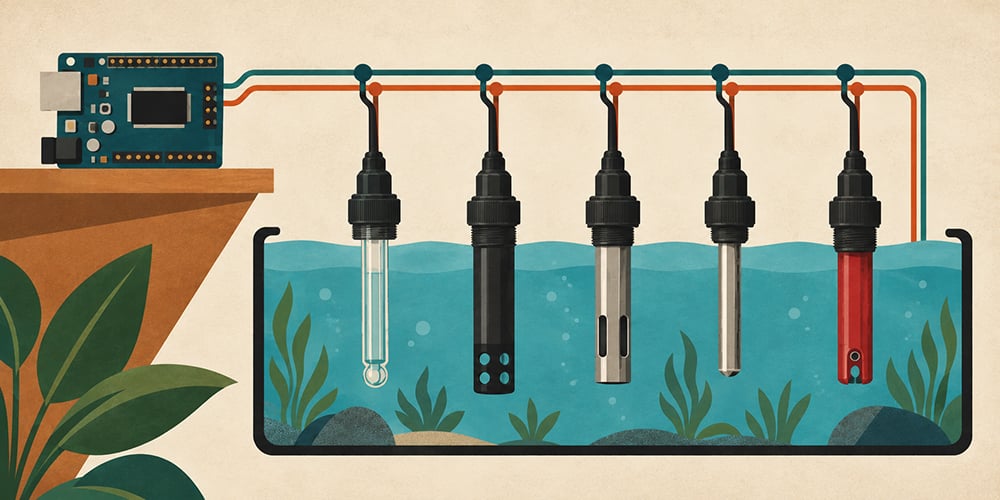
NOTE: Atlas Scientific’s EZO circuits support both UART and I2C modes and can be switched between them at any time. This gives you the flexibility to prototype with UART for simplicity, then migrate to I2C when you need to scale up.
The I2C includes a built-in (ACK/NACK) acknowledgement for each byte transferred. If data is being transferred from master to slave, the receiver acknowledges a byte by pulling SDA low during the ACK bit. If the master receives a NACK, it knows the transfer was not acknowledged.
In case of no acknowledgement, the master knows there is a problem. This slightly increases robustness because the master can detect when a device does not respond or a transfer cannot proceed as expected.
UART is without address space and any acknowledging system by default. The parity bit adds very little error detection capacity (the parity bit provides only limited error detection and cannot reliably detect all transmission errors). Usually, this is not a problem in short-distance sensor applications, but it can cause problems in noisy electrical environments.
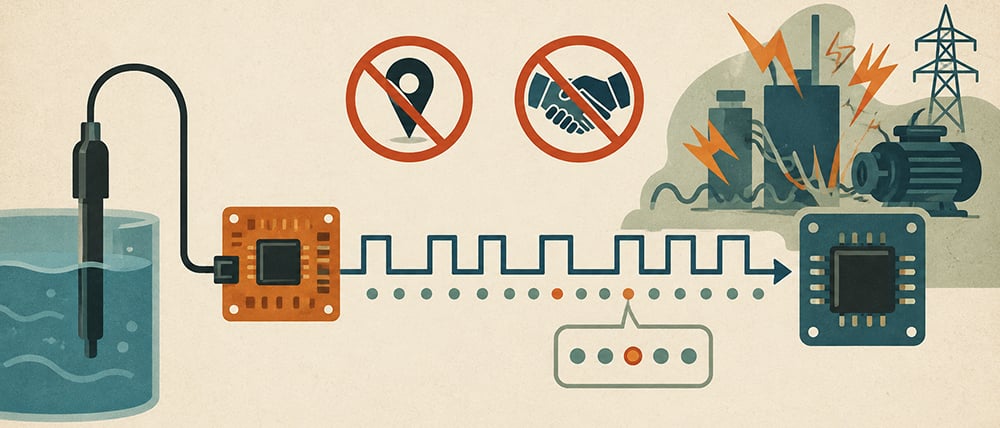
I2C was originally designed for communication between devices on the same PCB and generally works best over short cable lengths. UART is often more tolerant of longer cable runs, making it a better choice when sensors or peripherals must be located some distance from the microcontroller.
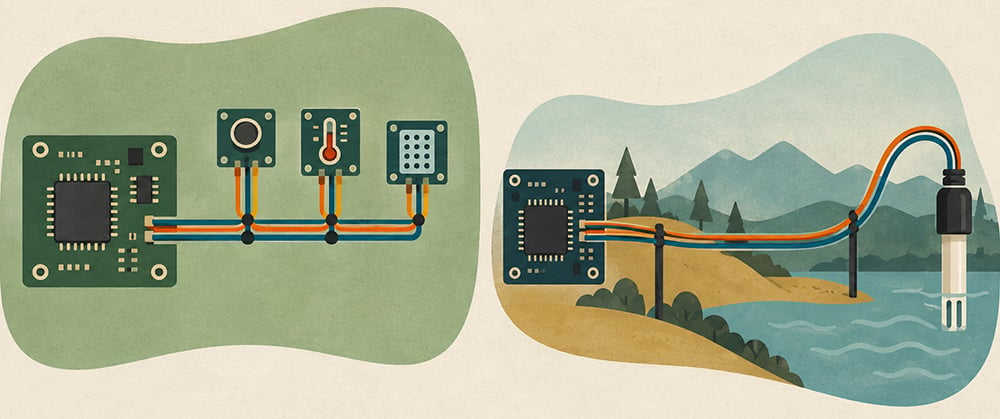
Choose UART if:
Choose I2C if:
For most multi-sensor scientific and environmental monitoring projects, the kind that Atlas Scientific sensors are built for, I2C is the natural choice. It’s tidy, scalable, and more than fast enough for electrochemical sensor readings.
Both the UART and I2C are excellent communication protocols, and by learning the ways in which they both work, you will gain a more capable embedded systems designer. The UART, for its simplicity, is perfect when connecting only two devices, when a no-fuss connection is all you will ever need. While the I2C, for its scalability, will always be the better choice when you have many sensors connected to the same bus.
If you are building a water quality monitoring system, a reef tank controller, an automated hydroponic nutrient dosing system, or any other sensor-heavy application, Atlas Scientific’s EZO sensor circuits are available in both UART and I2C modes, so you can choose the one best suited for your project.
If you need assistance choosing the right sensors and communication method for your project, feel free to contact the world-class team at Atlas Scientific.
Indoor air quality can have a major impact on the comfort and productivity of homes, offices, schools, laboratories, and industrial facilities. Carbon dioxide buildup, poor
UART and I2C are serial communication protocols, but they serve different purposes. UART is typically used for direct device-to-device communication and requires dedicated connections. I2C