

Blog
Color Sensor Applications in Industry, Water Quality, and Automation
Color sensors are used to measure and quantify color with a precision the human eye simply cannot match. They play a critical role in water





Color sensors are used to measure and quantify color with a precision the human eye simply cannot match. They play a critical role in water quality monitoring, hydroponic nutrient management, industrial sorting, product quality control, and aquaculture, converting reflected or transmitted light into objective RGB, CIE, and LUX data that drives automated decisions.
Most conversations about color sensors end with smartphones, TVs, and printers. But that’s only half the story. Color sensor applications in industrial and environmental monitoring are used to catch a process drifting out of spec before it becomes a costly batch failure, to flag a change in water chemistry long before it is visible to a technician, and to sort, grade, or verify products at a speed no human inspector could sustain.
At Atlas Scientific, we design embedded color sensors that are built to work in the field, not just on a lab bench, which is why our sensors are commonly deployed alongside our pH, dissolved oxygen, and temperature sensors as part of a broader environmental monitoring stack. In this guide, we will explore how color sensors work, examine real-world applications across several industries, compare sensor housing options, and cover integration and calibration practices to keep readings accurate over time.
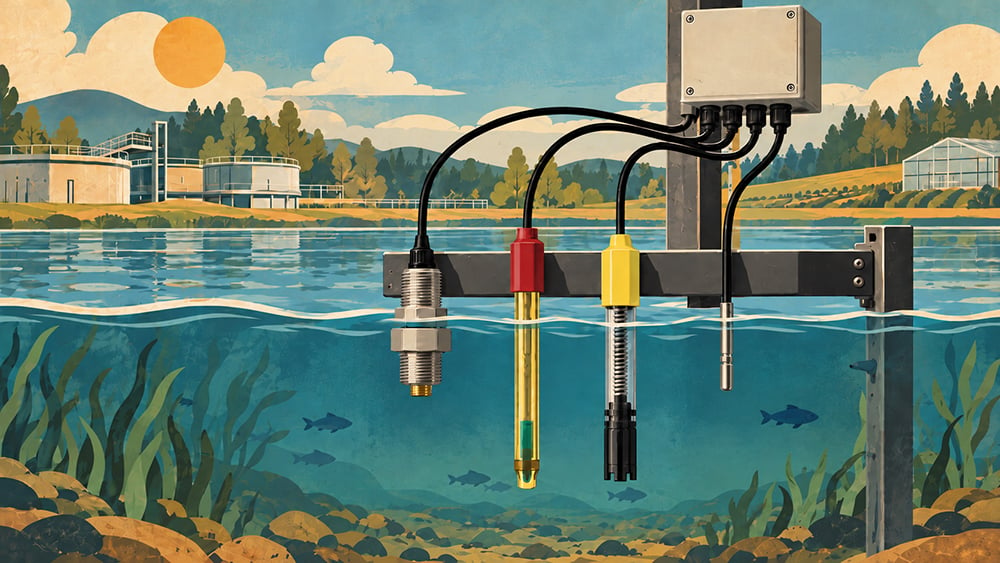
A color sensor measures the intensity of light reflected or emitted by a target across the red, green, and blue wavelength bands, then converts that data into a usable output.
The Atlas Scientific EZO-RGB™ Embedded Color Sensor reads color in three formats:
The sensor is least sensitive to blue light and most sensitive to red light, which is why it uses six onboard illuminator LEDs tuned to output strongest in the blue spectrum. This balances the sensor’s natural sensitivity curve against the light source, giving the best possible color-sensing performance regardless of ambient lighting conditions.
With a 15° half-angle sensing area and a response time of 400 milliseconds, it is fast enough for inline, real-time color sensor applications on a moving production line or in a continuously monitored tank.
Water color is a genuine indicator of water quality. Turbidity, algae blooms, industrial discharge, tannins, and iron content all shift the color of a water sample long before other parameters change. Embedding a submersible color sensor into a monitoring station allows utilities, researchers, and environmental agencies to continuously track color shift, rather than relying on periodic grab samples and visual inspection.
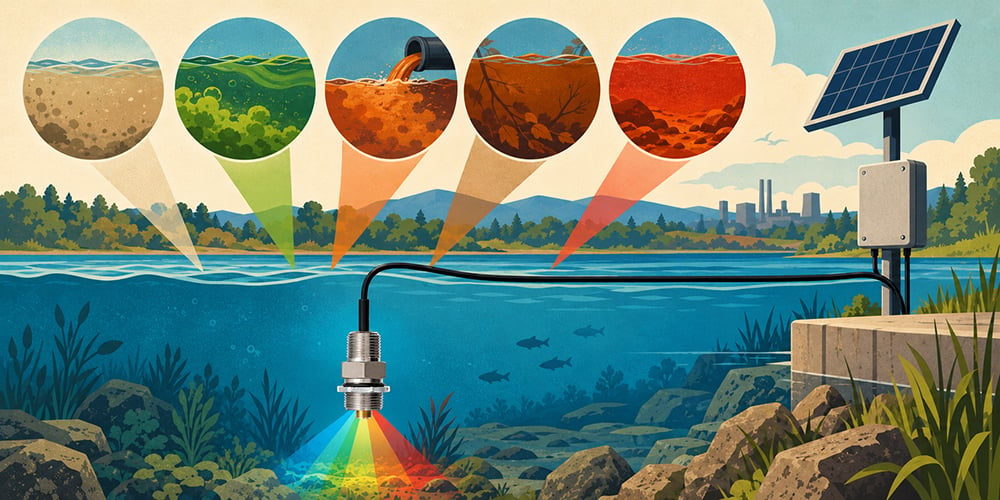
Because our EZO-RGB™ Embedded Color Sensor – Stainless Steel Body is rated IP67 and can be fully submerged (up to 1 meter in depth), it is well-suited for permanent installation in reservoirs, treatment basins, and outdoor monitoring stations where a plastic-bodied sensor would degrade over time. Pairing color data with dissolved oxygen and pH readings gives a far more complete picture of ecosystem health than any single parameter alone.
In controlled-environment agriculture, color sensor applications extend beyond the water itself. Growers use color data to track changes in nutrient solution, identify the early stages of nutrient lockout, and monitor plant tissue color as an early warning sign of stress, deficiency, or disease. A consistent, quantified color reading removes the guesswork of relying on a grower’s eye, which varies from person to person and shift to shift.
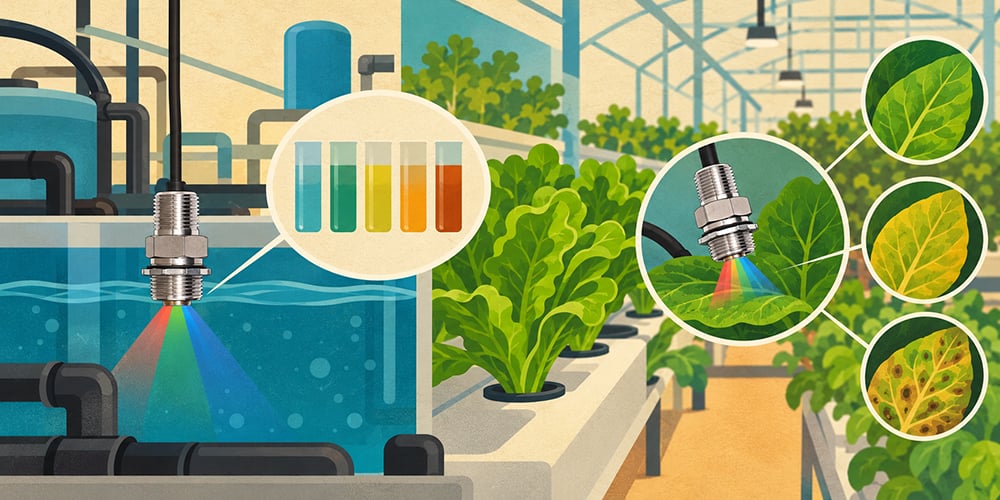
This complements the wider sensing stack we discuss in our guide to sensors for greenhouse monitoring, where temperature, humidity, and CO2 sensors already work together to protect crop yield. Adding color sensing closes the loop between nutrient chemistry and the physical result growers actually see on the plant.
On a production line, color sensor applications are used to sort components, verify packaging colors match brand specifications, and detect miswired or mismatched parts before they reach the next stage of assembly. Because color sensors output a digital signal, they integrate directly into PLCs (through a compatible controller) and automated sorting arms without needing a full machine vision system, making them a lower-cost, lower-complexity alternative when the task is genuinely a color-matching problem rather than a shape or defect-detection problem.

Recycling facilities use the same principle at scale, sorting plastics, glass, and packaging materials by color to improve the purity of recycled material streams. Response time matters here: a 400-millisecond reading cycle is fast enough to keep pace with conveyor-driven sorting without becoming the bottleneck in the line.
Color consistency is a brand promise. A paint manufacturer, textile producer, food processor, or cosmetics brand cannot afford visible batch-to-batch color variation, and human visual inspection is inherently subjective and fatigue-prone over the course of a full shift. A fixed-mount color sensor removes that subjectivity from the process, flagging any reading that falls outside a programmed tolerance in real time.
The EZO-RGB™ sensor’s programmable color-matching feature allows a target color to be stored directly on the sensor, so out-of-spec readings can trigger an alert or reject the signal without requiring constant intervention from a central control system.
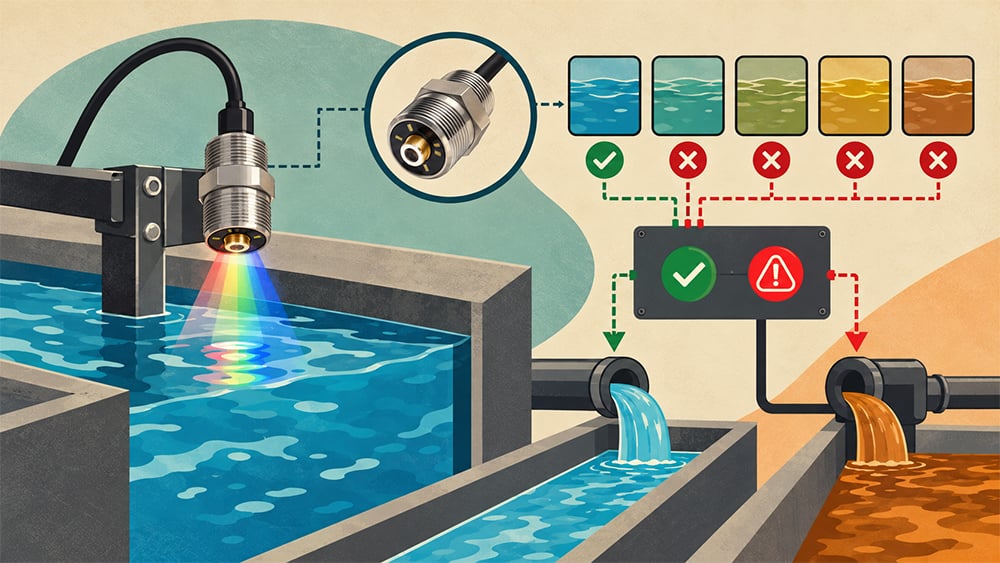
In fish farming and aquaculture systems, water color is tied closely to algae concentration, feed residue, and overall tank cleanliness. Because color shifts often precede more serious water quality problems, monitoring color alongside dissolved oxygen provides operators with a warning system rather than waiting for a critical oxygen or ammonia reading. This is especially valuable in high-density recirculating systems, where a rapid decline in water quality can affect an entire stock population within hours.
Selecting the correct body style is one of the most overlooked decisions in a color sensor application, and it directly impacts sensor lifespan and reading reliability.
Atlas Scientific offers the EZO-RGB™ sensor in two housing options, covering both submerged and general-purpose use cases.
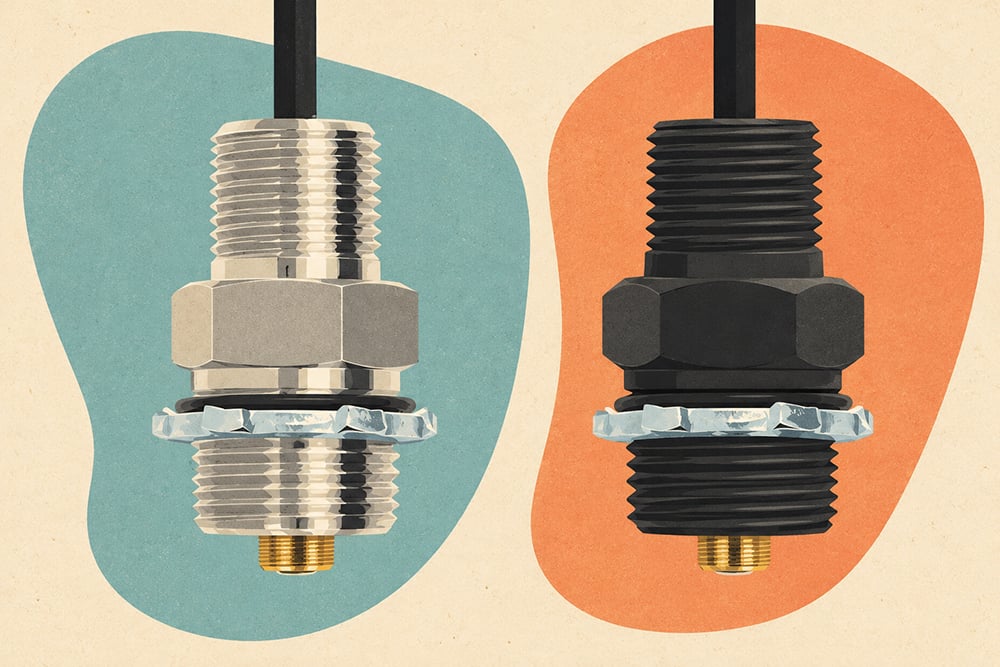
| Feature | EZO-RGB-S (Stainless Steel) | EZO-RGB-P (Plastic) |
| Body material | 316 Stainless Steel | Photosensitive resin |
| Best suited for | Submerged, harsh, or corrosive environments | General-purpose, indoor, or benchtop use |
| Waterproofing | IP67, submersible to 1 meter | IP67, submersible to 1 meter |
| Mounting | Multiple industrial mounting options | Versatile mounting options |
| Data protocol | UART & I2C | UART & I2C |
| Response time | 400ms | 400ms |
| Outputs | RGB (24-bit), CIE (xyY), LUX | RGB (24-bit), CIE (xyY), LUX |
As a general rule, we recommend the stainless steel body for any application involving permanent submersion, outdoor exposure, or chemical contact, and the plastic body for lower-cost integrations where the sensor is protected from moisture and physical wear.
For more detail on how housing choice affects long-term reliability across sensor types, see our article on sensor housing.
Every EZO-RGB™ sensor communicates over both UART and I2C, which makes it straightforward to connect to the platforms most commonly used in automation and research, including Arduino and Raspberry Pi.
We have published detailed walkthroughs on connecting a color sensor to an Arduino Uno and connecting a color sensor to a Raspberry Pi, both using the EZO™ Carrier Board and Adapter for a clean, isolated connection.
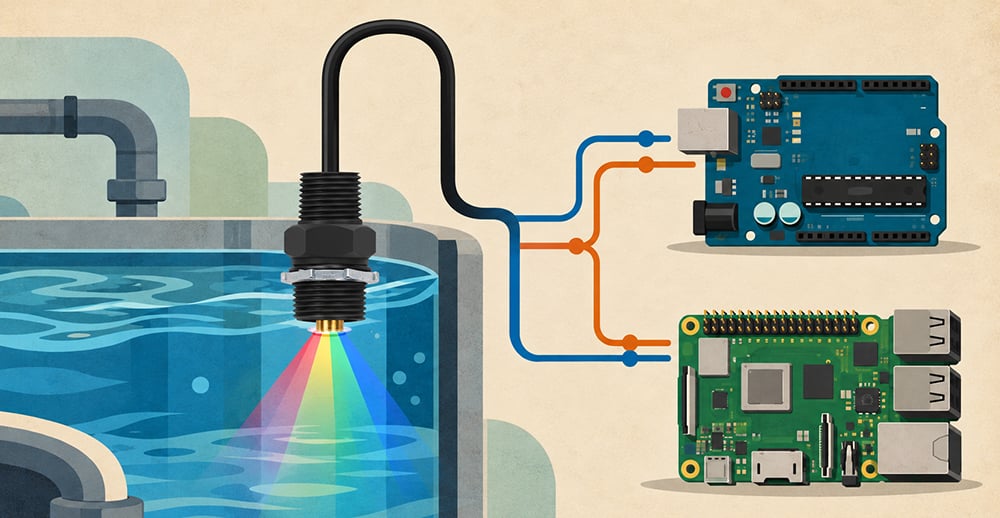
By default, sensors ship in UART mode, indicated by a blinking green LED; a solid blue LED indicates I2C mode. Because most Atlas Scientific EZO™ class sensors share this same connection method, a color sensor application can be added to an existing monitoring rig alongside pH, dissolved oxygen, or conductivity sensors without redesigning the wiring or control architecture.
Accurate color sensor applications depend on consistent lighting and a fixed sensing distance, more so than almost any other sensor type we manufacture. Because the sensor’s ability to detect color diminishes with distance, and colors begin to appear as shades of gray beyond roughly 45cm, mounting position is not a minor detail; it is the difference between a usable reading and a meaningless one.
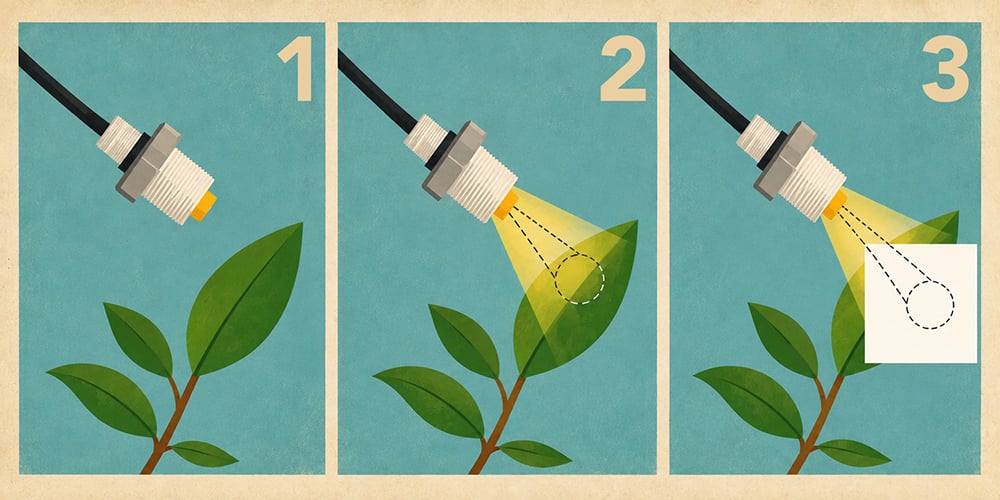
| Step | Action | Key Consideration |
| 1. Mounting | Install the sensor into its permanent, intended location | Avoid handheld calibration, which reduces accuracy |
| 2. LED Brightness | Set onboard LED brightness to the level the target will be viewed under | Match real operating conditions, not lab conditions |
| 3. White Calibration | Calibrate against a white reference object at that brightness | This anchors the sensor’s baseline reading |
| 4. Verification | Confirm readings against a known color standard | Repeat periodically, especially after cleaning |
A few additional guidelines we recommend across all of our color sensor applications:
Color sensor applications go far beyond the consumer electronics use cases most people think of first. Across water quality monitoring, hydroponics, industrial sorting, manufacturing quality control, and aquaculture, a reliable color sensor turns a subjective, visual judgment call into an objective, repeatable data point, one that can be logged, alarmed, and integrated directly into an automated control system.
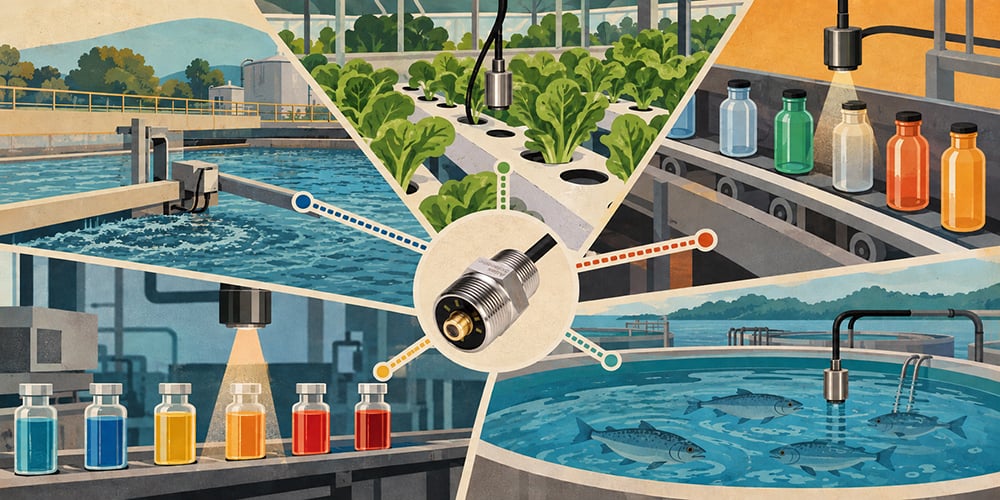
Whether you need a submersible sensor for a permanent outdoor installation or a cost-effective option for a benchtop or indoor build, Atlas Scientific’s EZO-RGB™ Embedded Color Sensor range is engineered to deliver laboratory-grade accuracy in the field. If you would like help choosing the right color sensor application for your project, do not hesitate to contact the world-class team at Atlas Scientific.
Color sensors are used to measure and quantify color with a precision the human eye simply cannot match. They play a critical role in water

Industrial pH monitoring sounds simple: connect a pH probe, measure the process, and send the reading to a PLC or control system. In practice, choosing