

Blog
The Best Industrial pH Transmitters
Industrial pH monitoring sounds simple: connect a pH probe, measure the process, and send the reading to a PLC or control system. In practice, choosing





Industrial pH monitoring sounds simple: connect a pH probe, measure the process, and send the reading to a PLC or control system. In practice, choosing the right transmitter can become complicated quickly.
Some industrial pH transmitters are sophisticated multiparameter analyzers with digital communications, relays, PID control, data logging, and proprietary sensor ecosystems. Those capabilities can be valuable in large process-control installations—but they can also add cost and complexity when the real requirement is simply accurate, dependable pH measurement delivered to a PLC over 4–20 mA.
For applications where simplicity, accuracy, sensor flexibility, and straightforward PLC integration matter most, the Atlas Scientific Industrial pH Transmitter makes a compelling case.
We compared it with several well-established industrial alternatives, including the Endress+Hauser Liquiline CM442, Yokogawa FLXA402, Hanna Instruments HI510, and Emerson Rosemount 56.

The Atlas Scientific Industrial pH Transmitter (IND-pH) takes a noticeably different approach from many traditional process analyzers.
Rather than trying to become an all-in-one plant controller, it concentrates on one job: getting an accurate pH measurement into an industrial control system without unnecessary complexity.
Atlas Scientific specifies a measurement range of 0.001 to 14.000 pH with ±0.002 pH accuracy, along with automatic temperature compensation, 1-, 2-, or 3-point calibration, electrical isolation, and a standard 4–20 mA output.
Atlas Scientific also allows calibration either directly onboard or remotely through the PLC.
The biggest advantage isn’t having more features. It’s eliminating features that many installations don’t actually need.

If a facility already has a PLC performing the control logic, why pay for another elaborate controller at the sensor?
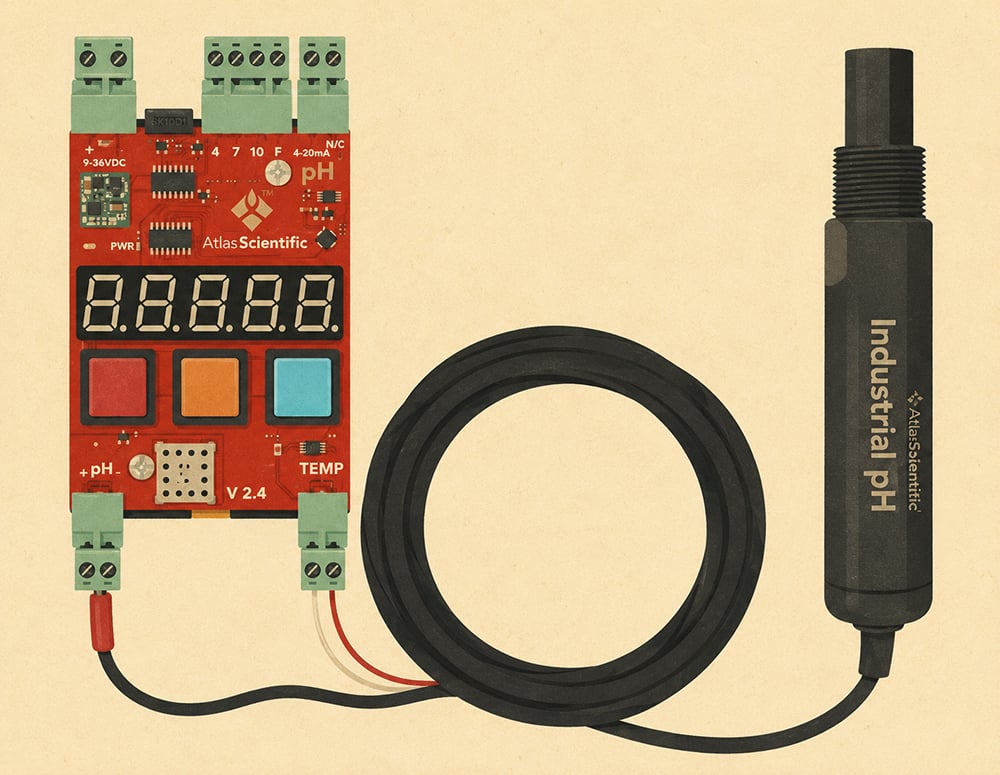
The IND-pH provides the measurement and sends it through the ubiquitous 4–20 mA industrial interface. That makes the architecture remarkably straightforward:
pH Probe → Atlas Industrial pH Transmitter → 4–20 mA → PLC
Its 9–36 VDC operating range and DIN-rail form factor are also particularly attractive for control-panel installations.
Another major advantage is sensor freedom. The transmitter isn’t designed around a proprietary digital probe ecosystem. That gives system designers considerably more flexibility when selecting or replacing a pH probe.
Atlas doesn’t provide HART, Ethernet, Bluetooth, onboard PID control, multiple measurement channels, or extensive data logging.
For some plants, those are important requirements.
But when the PLC is already responsible for automation, those capabilities may simply duplicate functionality that already exists elsewhere in the system.
Verdict: Best overall choice for dedicated industrial pH measurement and PLC integration.
The Endress+Hauser Liquiline CM442 is an impressive industrial instrument, but it serves a somewhat different purpose.
Rather than being solely a pH transmitter, the CM442 is a modular multiparameter platform capable of working with pH, ORP, conductivity, dissolved oxygen, turbidity, nitrate, and other measurements.
It supports one or two Memosens digital inputs and offers 0/4–20 mA outputs along with options including HART, PROFIBUS DP, Modbus RS485/RTU, Modbus TCP, EtherNet/IP and PROFINET.
That is a substantial communications advantage over Atlas.
However, that sophistication also means the CM442 is a considerably more elaborate system when the application requires only a single pH measurement.
Its use of the Memosens platform also means sensor selection is tied more closely to that digital ecosystem.
For a large facility that wants multiple analytical parameters, extensive digital communication, expandable modules, relays, and advanced diagnostics, the CM442 is the stronger platform.
For a PLC engineer who needs:
one pH probe + one accurate transmitter + one 4–20 mA signal
Atlas offers a considerably simpler solution.
Verdict: Excellent multiparameter platform, but potentially excessive for straightforward pH-to-PLC applications.
The Yokogawa FLXA402 is another serious industrial analyzer designed for sophisticated process installations.
Depending on configuration, it supports pH/ORP and additional analytical measurements along with 4–20 mA, HART, Ethernet Modbus TCP, RS-485 Modbus RTU and Bluetooth communications.
Yokogawa specifies isolated 4–20 mA outputs with ±0.02 mA accuracy and offers configurations with two or four analog outputs.
The FLXA402 therefore provides capabilities that Atlas simply does not attempt to match.
But again, the question is whether your installation actually needs them.
If all the facility requires is an isolated pH measurement entering an existing PLC, the additional communications and configuration options can become unnecessary overhead.
Choose the FLXA402 when advanced communications, multiple measurements, HART, Modbus, Bluetooth, or sophisticated plant-wide integration are requirements.
Choose Atlas when cost-conscious simplicity and direct 4–20 mA PLC integration are higher priorities.
Verdict: Powerful industrial analyzer, but Atlas is the cleaner solution for dedicated pH measurement.
The Hanna Instruments HI510 moves even further into controller territory.
It offers two or four configurable analog outputs, RS-485 communication, USB-C connectivity, data logging and as many as five configurable relays. It can also provide On/Off, proportional and PID process control.
That’s excellent if the pH instrument itself needs to operate pumps, valves, cleaning systems or other process equipment.
But the HI510 relies on Hanna’s compatible smart digital probes, whereas Atlas emphasizes broad pH probe compatibility.
The HI510 also uses a 100–240 VAC power supply, while the Atlas transmitter accepts 9–36 VDC, which can make Atlas particularly convenient inside DC-powered industrial control cabinets.
If you want the instrument itself to perform PID control, operate relays, log data and control equipment, the HI510 provides considerably more functionality.
If your PLC already performs those functions, Atlas eliminates much of that duplication.
Verdict: Strong standalone process controller; Atlas is simpler for PLC-centric systems.
The Rosemount 56 is another high-end option designed for considerably more than basic pH transmission.
It is a dual-channel transmitter supporting pH/ORP, ISE, conductivity, turbidity, dissolved oxygen, chlorine, ozone and other analytical measurements. It also offers features such as data logging, PID control and HART or PROFIBUS digital communications.
For pH applications, documentation specifies a standard 0–14 pH range, with scalable 0/4–20 mA output options depending on configuration.
Again, this is an excellent platform when those capabilities are required.
For a single measurement point connected to a PLC, however, you’re comparing an advanced analytical controller against a transmitter purpose-built around a much narrower task.
Verdict: Excellent for sophisticated dual-channel installations; Atlas wins on simplicity for dedicated pH monitoring.
| Feature | Atlas Scientific Industrial pH Transmitter | Endress+Hauser Liquiline CM442 | Yokogawa FLXA402 | Hanna HI510 | Emerson Rosemount 56 |
|---|---|---|---|---|---|
| Primary Purpose | Dedicated pH transmitter | Multiparameter transmitter | Multiparameter analyzer | Process controller | Multiparameter transmitter |
| pH Range | 0.001–14.000 | Sensor/configuration dependent | Sensor/configuration dependent | pH supported | 0–14 pH |
| Stated pH Accuracy | ±0.002 pH | System/sensor dependent | System/sensor dependent | System/probe dependent | System/sensor dependent |
| 4–20 mA | Yes | Yes | Yes | Yes | Yes |
| Electrical Isolation | Yes | Configuration dependent | Isolated outputs | Galvanically isolated analog outputs | Yes/configuration dependent |
| Temperature Compensation | Automatic | Yes with compatible sensor | Yes | Yes with compatible smart probe | Yes with compatible sensor |
| Temperature Sensor | PT-100 or PT-1000 | Memosens ecosystem | Configuration dependent | Hanna smart probe system | Sensor dependent |
| Probe Compatibility | Any brand/type of conventional pH probe* | Primarily Memosens-compatible sensors | Depends on installed input module | Hanna HI10X6 smart probes | Compatible sensor/input configurations |
| Calibration | 1, 2 or 3 point | Supported | Supported | Supported | Supported |
| DIN-Rail Mount | 35 mm DIN rail | Field enclosure | Field/panel configuration | ½ DIN panel/wall/pipe options | Field/panel installation |
| Supply Voltage | 9–36 VDC | Configuration dependent | 100–240 VAC or 12–24 VDC versions | 100–240 VAC | Line powered |
| Digital Communications | No | HART / PROFIBUS / Modbus / Ethernet options | HART / Modbus / Bluetooth options | RS-485 | HART / PROFIBUS options |
| Multiparameter | No — purpose-built for pH | Yes | Yes | Multiple compatible process parameters | Yes |
| Current Atlas List Price | $259.99 | Quote/configuration dependent | Configuration dependent | Configuration dependent | Configuration dependent |
| Best Fit | PLC-based pH monitoring where simplicity, accuracy and flexibility matter | Large multiparameter plants | Advanced process automation | Integrated process control | Advanced industrial analysis |
*Probe compatibility should still be checked for electrical and installation suitability.
Specifications vary by configuration, particularly for the multiparameter competitors. Always verify the exact configured model before purchasing.
There isn’t one industrial pH transmitter that is objectively superior for every possible installation.
A facility requiring PROFIBUS, HART, PID control, multiple analytical parameters, multiple channels or extensive onboard diagnostics may be better served by Endress+Hauser, Yokogawa, Hanna or Emerson.
But that’s exactly what makes the Atlas Scientific Industrial pH Transmitter interesting.
It isn’t trying to replace the PLC.
It is designed to work with it.
For the common industrial requirement of measuring pH accurately and getting that measurement reliably into an existing control system, Atlas provides an unusually attractive combination of:
±0.002 pH stated accuracy + 4–20 mA output + electrical isolation + automatic temperature compensation + broad probe compatibility + 35 mm DIN-rail mounting + 9–36 VDC operation.
And Atlas currently lists the transmitter at $259.99, with published quantity discounts beginning at four units.
That makes it particularly compelling for OEM equipment, water-treatment skids, dosing systems, hydroponics and aquaculture equipment, industrial control panels, research systems, process equipment and other installations where the PLC already handles the heavy lifting.
If the same system also needs conductivity, Atlas builds a matching transmitter on the same DIN-rail, 4–20 mA architecture — we compared the leading industrial conductivity transmitters separately.
The more features a transmitter has, the better it looks on a specification sheet.
But more isn’t automatically better.
When you already have a PLC, the best transmitter may be the one that accurately measures pH, converts the measurement into a reliable industrial signal, and stays out of the way.
That’s where the Atlas Scientific Industrial pH Transmitter earns our top recommendation.
The Endress+Hauser CM442 and Yokogawa FLXA402 provide more advanced communications. The Hanna HI510 and Rosemount 56 provide substantially more onboard control capability.
But for engineers looking specifically for a dedicated industrial pH transmitter that is accurate, electrically isolated, DIN-rail mountable, flexible about probe selection, easy to integrate and reasonably priced, Atlas Scientific provides the strongest overall balance.
Best for: PLC integration, OEM equipment, industrial control cabinets, water treatment, dosing systems and straightforward continuous pH monitoring.
Bottom line: If you need an entire analytical control platform, several competitors offer more features. If you need a high-accuracy industrial pH transmitter that simply does its job and integrates cleanly with a PLC, Atlas Scientific is the one to beat.
Industrial pH monitoring sounds simple: connect a pH probe, measure the process, and send the reading to a PLC or control system. In practice, choosing

The 4-20mA current loop is the dominant analog signaling method in industrial process control. It transmits sensor measurements, such as temperature, pressure, pH, and flow,