

Blog
The Best Industrial Conductivity Transmitters
Conductivity is one of the most important measurements in industrial water systems. From water treatment and hydroponics to chemical processing and manufacturing, conductivity provides a





Conductivity is one of the most important measurements in industrial water systems. From water treatment and hydroponics to chemical processing and manufacturing, conductivity provides a fast and reliable indication of the concentration of dissolved ionic material in a solution.
But measuring conductivity is only part of the challenge.
In an industrial environment, the measurement needs to be converted into a signal that can be reliably transmitted to a PLC, control system, or data acquisition system. That is where an industrial conductivity transmitter comes in.
There are plenty of sophisticated conductivity analyzers available, but sophisticated does not always mean better. For many installations, engineers simply need an accurate conductivity measurement, automatic temperature compensation, electrical isolation, standard 4–20 mA output, and straightforward PLC integration.
We compared several industrial solutions from Atlas Scientific, Endress+Hauser, Yokogawa, and GF Signet to see how they stack up.
The Atlas Scientific Industrial Conductivity Transmitter (IND-EC) takes a refreshingly straightforward approach to industrial conductivity monitoring.
Rather than building a large multiparameter analyzer around the measurement, Atlas Scientific provides the functionality many automation engineers actually need: conductivity in and 4–20 mA out.
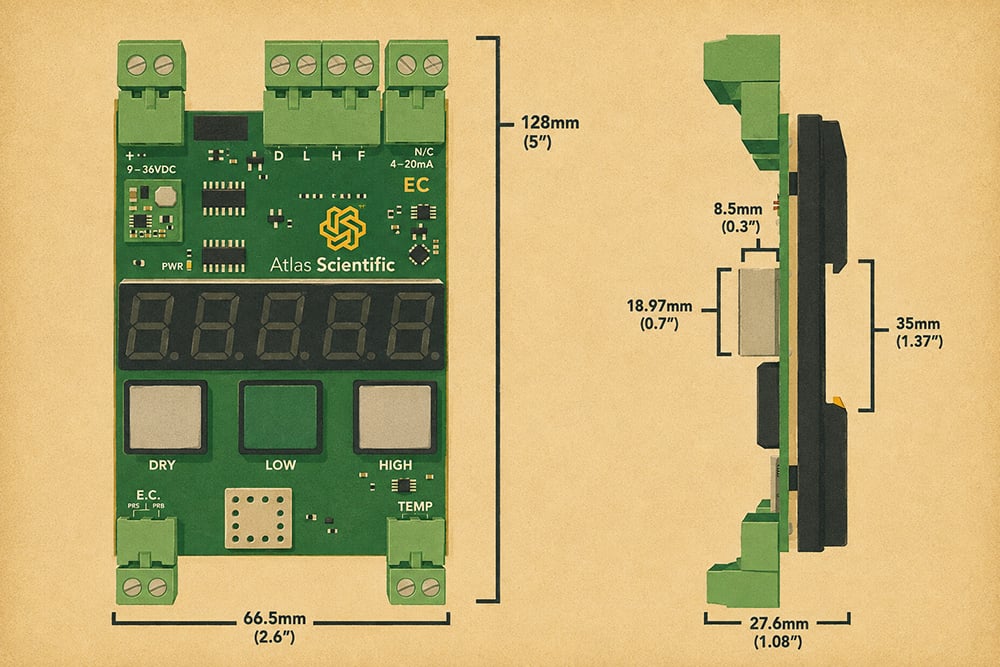
The transmitter measures from 0.07 µS/cm to 100,000 µS/cm, with a stated accuracy of ±2%. It supports 1- or 2-point calibration and can be calibrated either directly on the transmitter or remotely through a PLC.
One of its biggest advantages is probe flexibility. Atlas specifies support for two-lead conductivity probes with cell constants K 0.01, K 0.1, K 1.0, and K 10, giving system designers considerable freedom when selecting a conductivity probe.
Temperature compensation is built in, with support for both PT-100 and PT-1000 temperature probes.
The transmitter outputs a standard 4–20 mA signal, operates from 9–36 VDC, is electrically isolated, and snaps onto a standard 35 mm DIN rail.
Atlas Scientific also lists the transmitter as ISO 7888 compliant for determination of electrical conductivity.
And then there is the price.
At the time of this comparison, Atlas Scientific lists the transmitter at $329.99, with quantity discounts bringing the price lower for larger orders.
The Atlas transmitter isn’t trying to be an entire water-quality control station.

That’s precisely its advantage.
If an application requires a conductivity probe connected to a PLC using a reliable 4–20 mA signal, Atlas provides the necessary functionality without requiring the customer to invest in a larger multiparameter analyzer or proprietary digital sensor ecosystem.
For OEMs, machine builders, automation engineers, and industrial users who already have a PLC handling the interface and control logic, the Atlas Scientific transmitter offers an excellent balance of capability, simplicity, and cost.
The Endress+Hauser Liquiline CM442 is a much more sophisticated instrument.
Rather than being strictly a conductivity transmitter, the CM442 is a configurable 1- or 2-channel multiparameter transmitter capable of working with measurements including conductivity, pH, ORP, dissolved oxygen, chlorine, turbidity, nitrate, and others.
The system uses Endress+Hauser’s Memosens digital sensor platform and supports two to four 0/4–20 mA outputs, relays, additional digital communication options, and IP66/IP67 protection.
Its modular design also makes it possible to expand functionality as an installation grows.
That’s extremely valuable in a large process plant.
However, it can be considerably more system than necessary when the application is simply:
conductivity probe → transmitter → PLC.
The Atlas Scientific approach is considerably simpler for that particular requirement.
Choose the CM442 when you need multiple measurement parameters, Memosens digital sensors, sophisticated diagnostics, additional channels, relays, fieldbus options, or a larger process-analysis ecosystem.
For a dedicated conductivity measurement point, Atlas eliminates much of that complexity and provides a compact DIN-rail device specifically designed to deliver conductivity measurements to a PLC.
The Yokogawa FLXA402 is another highly capable industrial analyzer.
Like the Endress+Hauser system, the FLXA402 is designed around multiparameter process analysis rather than conductivity alone.
Depending on its installed modules, the FLXA402 can measure parameters including:
It also features a color HMI with touchscreen operation and can support dual-sensor measurement.
Configurations are available with two or four 4–20 mA outputs, with HART support on the first output.
That’s an impressive feature set.
But again, those capabilities make the most sense when the application actually needs them.
If the objective is simply to integrate conductivity into an existing PLC system, the Atlas Scientific transmitter provides a substantially more streamlined solution.
Rather than paying for an HMI, multiple measurement modes, additional sensor channels, and advanced analyzer functionality, Atlas concentrates on the conductivity-to-PLC connection.
Best choice: Yokogawa for sophisticated process analyzer installations; Atlas Scientific for straightforward conductivity-to-PLC integration.

The GF Signet 9900 takes another approach.
It is a single-channel multiparameter transmitter capable of handling conductivity/resistivity as well as flow, pH/ORP, salinity, temperature, pressure, level, dissolved oxygen, and other measurements.
Its modular design is one of its strengths.
Additional capabilities can be added through optional modules, including additional 4–20 mA output, relays, conductivity/resistivity functionality, HART communication, Modbus RTU, and batch control.
But conductivity illustrates an important difference between the GF and Atlas approaches.
GF’s documentation specifies that conductivity/resistivity measurement requires either the appropriate Direct Conductivity/Resistivity Module or compatible Signet conductivity sensor electronics.
Atlas instead provides conductivity measurement as the transmitter’s core purpose.
That makes the Atlas approach particularly attractive when conductivity is the only parameter that needs to be added to a PLC.
| Feature | Atlas Scientific Industrial Conductivity Transmitter | Endress+Hauser Liquiline CM442 | Yokogawa FLXA402 | GF Signet 9900 |
|---|---|---|---|---|
| Conductivity Measurement | Yes | Yes | Yes | Yes |
| Dedicated Conductivity Solution | Yes | Multiparameter | Multiparameter | Multiparameter |
| Conductivity Range | 0.07–100,000 µS/cm | Depends on connected sensor | Depends on sensor/module | Depends on electrode/module |
| Stated Atlas Measurement Accuracy | ±2% | Sensor/configuration dependent | Sensor/configuration dependent | Sensor/configuration dependent |
| Temperature Compensation | Automatic | Supported with appropriate sensor/configuration | Supported | Supported |
| Temperature Sensor | PT-100 or PT-1000 | Sensor dependent | Sensor dependent | Sensor dependent |
| Conductivity Probe Compatibility | Any 2-lead conductivity probe; K 0.01, 0.1, 1.0, 10 | Memosens ecosystem | Compatible Yokogawa sensor modules | Signet electrodes/modules |
| Analog Output | 4–20 mA | 2–4 × 0/4–20 mA | 2 or 4 × 4–20 mA configurations | 4–20 mA |
| Electrical Isolation | Yes | Industrial isolation architecture | Industrial analyzer architecture | Low-voltage isolation specified |
| PLC Integration | Excellent | Excellent | Excellent | Excellent |
| Operating Voltage | 9–36 VDC | Configuration dependent | Configuration dependent | 10.8–35.2 VDC |
| DIN Rail Mount | 35 mm DIN rail | Field transmitter | Field/panel installation | Panel/field mount |
| Calibration | 1 or 2 point; local or remotely through PLC | Configuration dependent | Configuration dependent | Sensor/configuration dependent |
| ISO 7888 Compliant | Yes | — | — | — |
| Multiparameter Capability | No | Yes | Yes | Yes |
| Current Listed Price | $329.99 | Quote/configuration based | Quote/configuration based | Configuration dependent |
| Best For | Simple PLC conductivity monitoring | Large multiparameter systems | Advanced process analysis | Modular process monitoring |
There is no universal “best” conductivity transmitter for every possible industrial installation.
A large wastewater treatment facility building a multiparameter measurement network may benefit more from an Endress+Hauser or Yokogawa platform. A facility standardized around GF instrumentation may find the 9900’s modular ecosystem attractive.
But those aren’t necessarily the requirements of every industrial conductivity application.
For a large number of engineers, the actual requirement is much simpler:
Measure conductivity accurately, compensate for temperature, and send the result to a PLC.
And that’s where the Atlas Scientific Industrial Conductivity Transmitter stands out.
Atlas provides:
Probe → Transmitter → 4–20 mA → PLC
No touchscreen is required. No large field analyzer is required. No multiparameter measurement platform is necessary.
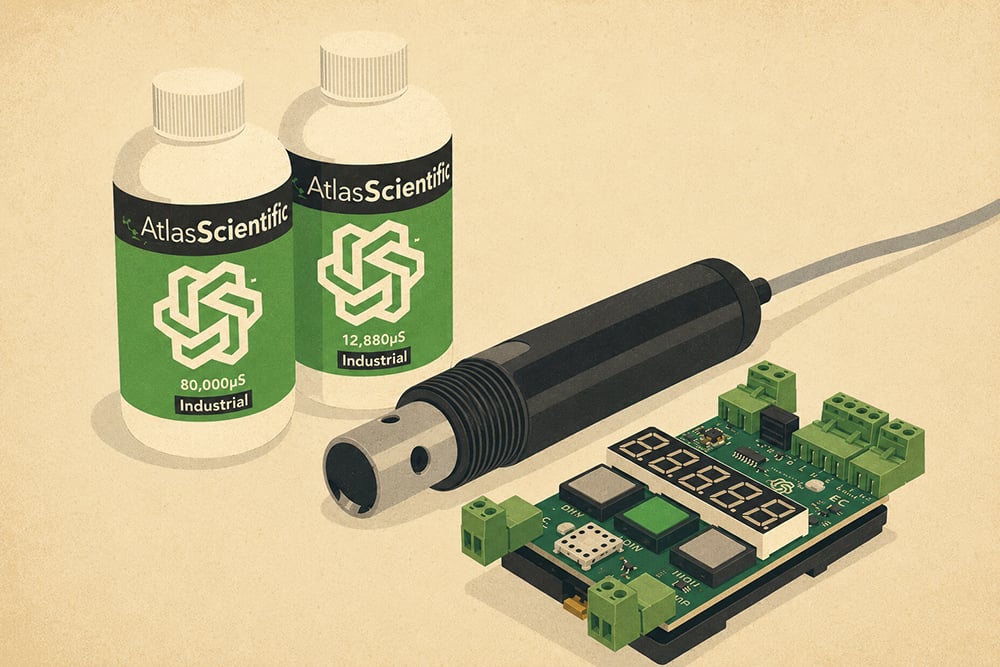
Just a compact, isolated, DIN-rail-mounted industrial transmitter built around the conductivity measurement.
Best Overall for PLC-Based Conductivity Monitoring: Atlas Scientific Industrial Conductivity Transmitter
The Endress+Hauser, Yokogawa, and GF Signet systems are all powerful industrial products. In fact, some offer substantially more functionality than the Atlas Scientific transmitter.
But more functionality isn’t automatically better value.
For an engineer who needs reliable conductivity measurement integrated into an existing PLC, the Atlas Scientific Industrial Conductivity Transmitter offers the most compelling combination of simplicity, probe flexibility, industrial 4–20 mA output, electrical isolation, DIN-rail installation, and price.
At $329.99, it also makes industrial conductivity monitoring accessible without forcing customers into an unnecessarily complicated instrumentation platform.
For dedicated industrial conductivity-to-PLC applications, Atlas Scientific is our winner.
Conductivity is one of the most important measurements in industrial water systems. From water treatment and hydroponics to chemical processing and manufacturing, conductivity provides a

When a process requires more than one chemical, nutrient, reagent, or additive, using several independent dosing pumps can quickly become complicated. A multi-pump dosing system