

Blog
The Best Multi-Pump Dosing Systems
When a process requires more than one chemical, nutrient, reagent, or additive, using several independent dosing pumps can quickly become complicated. A multi-pump dosing system







When a process requires more than one chemical, nutrient, reagent, or additive, using several independent dosing pumps can quickly become complicated. A multi-pump dosing system combines multiple dosing channels into a single platform, making it easier to automate fluid handling while reducing wiring, installation complexity, and equipment footprint.
These systems are commonly used in hydroponics, water treatment, laboratory automation, aquaculture, chemical processing, nutrient management, and automated equipment. However, multi-pump systems can differ significantly in how accurately they dispense liquids and, perhaps more importantly, how much control they give the engineer or operator.
For this comparison, we’ll look at several approaches to multi-channel dosing, including the Atlas Scientific TRI-PMP-BX™, Bluelab PeriPod M3, GHL Doser 3, and Jebao DP-4.
For engineers building an automated machine or monitoring system, the Atlas Scientific TRI-PMP-BX™ stands out as our overall winner because it combines three independently controllable pumps with high dosing accuracy, simultaneous operation, multiple dosing modes, and straightforward I²C integration.

Best for: Engineers, OEM equipment, automated water systems, laboratories, hydroponics, aquaculture, and custom dosing systems
The Atlas Scientific TRI-PMP-BX™ takes a different approach from many conventional multi-channel dosing products.
Instead of building the system around a proprietary user interface or limiting operation to predetermined dosing schedules, Atlas Scientific designed the TRI-PMP-BX around machine integration.
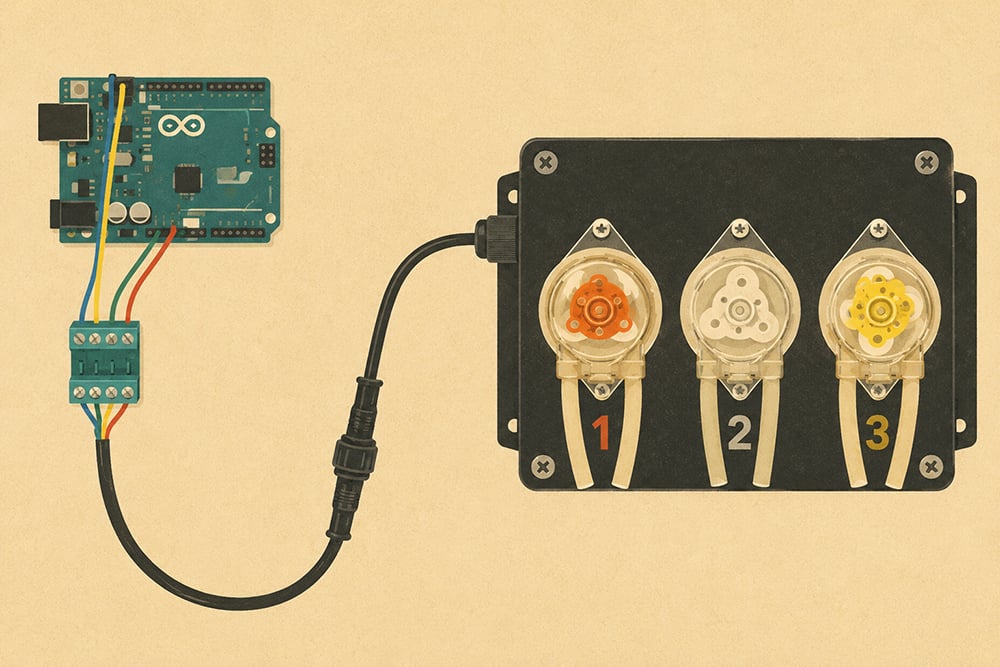
Inside its compact aluminum enclosure are three independently controlled peristaltic pumps, each with its own controller board.
Each pump has a specified flow range of 0.5 mL/min to 105 mL/min and published accuracy of ±1%. More importantly, all three pumps can operate simultaneously.
That makes the system particularly useful when several fluids need to be precisely controlled within the same process.
Each TRI-PMP-BX pump supports several different methods of fluid delivery:
This flexibility is one of the TRI-PMP-BX’s strongest advantages.
Instead of forcing an engineer to build all of the dosing logic externally, the pumps already understand commands for common dosing operations.
For example, a machine could command one pump to dispense a specific volume while another maintains a constant flow rate.
The TRI-PMP-BX communicates using I²C with ASCII-formatted commands.
The three pumps use separate default I²C addresses:
This allows a microcontroller or computer to address each pump individually.
Atlas Scientific also provides sample code for Arduino and Raspberry Pi, making the system particularly attractive for developers building their own automated equipment.
The TRI-PMP-BX isn’t just three loose pumps mounted next to each other.
The complete system includes:
The enclosure is rated IP64, while each pump can achieve a pump head of up to 8.1 meters (26.5 ft).
For an engineer who needs to integrate multiple pumps into a larger machine, this packaged design can significantly simplify installation.
Our verdict: The TRI-PMP-BX is especially compelling when the dosing pumps need to become part of a larger automated machine rather than operate as an isolated appliance.
Best for: Commercial hydroponics and nutrient reservoirs
The Bluelab PeriPod M3 is another three-pump peristaltic dosing system, but its design philosophy is substantially different.
Rather than targeting general-purpose engineering applications, the PeriPod is primarily designed for automated hydroponic nutrient and pH management.
Its three pumps can be configured for pH adjustment and nutrient solutions, and the M3 has a nominal flow rate of 120 mL/min per pump.
That makes it well suited to dosing larger hydroponic reservoirs.
Bluelab specifies flow-rate accuracy of ±10% under its stated conditions, compared with the ±1% accuracy specified for the TRI-PMP-BX.
The PeriPod is also designed to work with products such as the Bluelab Pro Controller, making it particularly convenient if your facility already operates within the Bluelab ecosystem.
For hydroponic growers already using Bluelab equipment, the PeriPod makes a great deal of sense.
For developers creating custom machinery, however, the TRI-PMP-BX provides a much more engineering-oriented interface.
Instead of designing around a dedicated nutrient-management ecosystem, developers can communicate directly with the Atlas pumps over I²C and incorporate their own sensors, software, control algorithms, and automation logic.
Our verdict: Excellent for Hydroponics
Best for: High-end reef aquariums and advanced aquarium automation
The GHL Doser 3 represents the premium end of aquarium dosing.
Its PrecisionDrive technology uses 24 V stepper motors with planetary gearing, and the system is designed for very small, controlled doses. GHL offers both standalone and expansion configurations, allowing users to build increasingly sophisticated dosing installations.
This makes the Doser 3 particularly attractive for advanced reef aquariums where small quantities of alkalinity supplements, calcium, magnesium, trace elements, or other additives need to be delivered on a schedule.
Its biggest strength is also what separates it from the TRI-PMP-BX.
The GHL Doser is fundamentally designed around the aquarium automation ecosystem, while the TRI-PMP-BX is designed as a component that engineers can embed into their own equipment.
For a reef aquarium, GHL’s software and ecosystem can be extremely convenient.
But an engineer building a water-treatment skid, laboratory instrument, automated hydroponic system, chemical dispenser, or custom IoT device may not want an aquarium-oriented ecosystem.
The TRI-PMP-BX provides direct pump-level control that makes it easier to build dosing functionality into a completely custom machine.
Our verdict: Excellent Premium Aquarium System
Best for: Cost-conscious aquarium hobbyists
The Jebao DP-4 approaches the problem from the opposite direction.
Rather than targeting engineers or sophisticated industrial automation, the DP-4 is primarily a budget-friendly four-channel aquarium dosing pump.
For hobbyists who simply need several additives delivered according to a schedule, that can be perfectly adequate.
The system’s biggest attraction is simplicity and affordability.
But that simplicity becomes a disadvantage when the pump needs to be integrated into a larger automated system.
The TRI-PMP-BX is designed to receive commands from an external controller and execute sophisticated dosing operations. That provides considerably more freedom for custom automation.
The two products are really intended for different users.
The Jebao is primarily an end-user aquarium appliance.
The TRI-PMP-BX is an engineering component.
If you’re building a machine that needs software-controlled dosing, feedback from sensors, variable flow rates, precise volume dispensing, or custom automation logic, the Atlas system is the stronger platform.
Our verdict: Good Budget Aquarium Option
| Feature | Atlas Scientific TRI-PMP-BX™ | Bluelab PeriPod M3 | GHL Doser 3 | Jebao DP-4 |
|---|---|---|---|---|
| Pump Channels | 3 | 3 | Multi-channel configurations | 4 |
| Per-Pump Flow Rate | 0.5–105 mL/min | 120 mL/min nominal | Application/configuration dependent | Primarily aquarium dosing |
| Published Flow/Dosing Accuracy | ±1% | ±10% flow-rate accuracy* | Precision-oriented dosing | Application dependent |
| Independent Pump Control | Yes | Yes | Yes | Yes |
| Simultaneous Pump Operation | Yes — all 3 | Application/controller dependent | System dependent | Schedule dependent |
| Direct Machine Communication | I²C | Designed around Bluelab controller ecosystem | Primarily GHL ecosystem | Built-in controller |
| Multiple Pump Operating Modes | Yes | Primarily controller-triggered dosing | Yes | Scheduled dosing |
| Constant Flow Rate Mode | Yes | Controller dependent | Application dependent | Not its primary design |
| Dose-Over-Time Mode | Yes | Controller dependent | Scheduling functionality | Scheduled dosing |
| Volume Dispensing | Yes | Yes, through control system | Yes | Yes |
| Enclosure | IP64 aluminum | Rugged wall-mount housing | Desktop/wall installation | Consumer aquarium enclosure |
| Best Application | OEM, engineering & automation | Hydroponic nutrient control | Advanced aquariums | Budget aquarium dosing |
*Bluelab states that actual flow accuracy depends on factors including temperature, pumped liquid, and tubing condition.
There isn’t one dosing pump that’s perfect for every possible application.

Bluelab offers an attractive system for growers already using its hydroponic control equipment. GHL offers an exceptionally sophisticated platform for premium aquariums. Jebao provides an affordable solution for basic multi-channel aquarium dosing.
But the Atlas Scientific TRI-PMP-BX™ offers something different: freedom to build the dosing system around your application.
The three pumps aren’t simply controlled by a predefined dosing schedule. They can receive individual commands from an external controller and perform multiple types of dosing operations.
That opens the door to considerably more advanced automation.
Imagine an automated hydroponic system where:
Instead of relying exclusively on a timer, the controlling computer could make dosing decisions based on measurements coming from pH, electrical conductivity, temperature, dissolved oxygen, or other sensors.
The same concept can be applied to water treatment, aquaculture, laboratories, chemical processing, environmental monitoring, and OEM equipment.
That flexibility is why we consider the Atlas Scientific TRI-PMP-BX™ the strongest overall choice for engineers and developers building automated multi-fluid dosing systems.
If you simply need several pumps to dispense aquarium additives on a schedule, there are plenty of inexpensive multi-channel dosing systems available.
If you’re already committed to a particular hydroponic or aquarium automation ecosystem, choosing that manufacturer’s dosing equipment may also make sense.
But if you’re an engineer, developer, researcher, or equipment manufacturer looking for a multi-pump dosing system that can become part of your own automated equipment, the requirements are different.
You need precision, control, communication, flexibility, and integration.
That’s where the Atlas Scientific TRI-PMP-BX™ separates itself from conventional multi-channel dosing pumps.
With three independently controllable pumps, ±1% accuracy, a 0.5–105 mL/min flow range per pump, simultaneous pump operation, five dispensing modes, I²C communication, and a rugged IP64 aluminum enclosure, the TRI-PMP-BX provides the tools needed to build sophisticated dosing automation without forcing the application into a proprietary control ecosystem.
For custom automation and OEM integration, the Atlas Scientific TRI-PMP-BX™ is our pick for the best multi-pump dosing system.
When a process requires more than one chemical, nutrient, reagent, or additive, using several independent dosing pumps can quickly become complicated. A multi-pump dosing system

Dissolved oxygen is one of the most important measurements in water treatment, aquaculture, environmental monitoring, industrial processing, research, and many other applications. When a dissolved