

Blog
The Best Indoor Air Quality Monitors
Indoor air quality can have a major impact on the comfort and productivity of homes, offices, schools, laboratories, and industrial facilities. Carbon dioxide buildup, poor




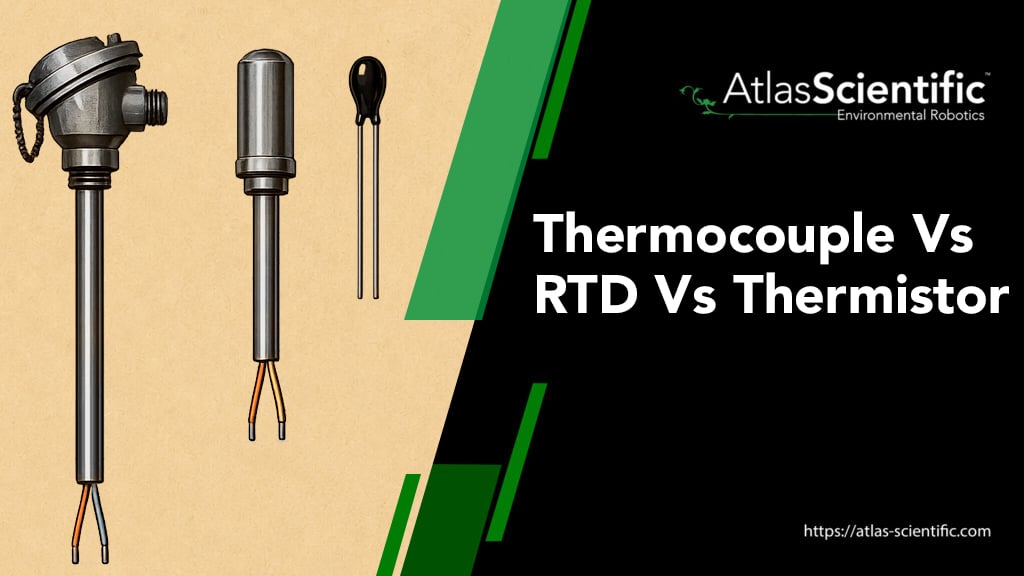
Thermocouples, RTDs, and thermistors all measure temperature, but they are better at different things. Thermocouples can handle very high temperatures, thermistors are very sensitive over a small range, and RTDs are the most accurate and stable sensors for most industrial and scientific uses. This guide shows how each sensor works, what its pros and cons are, and how to choose the best technology for your specific temperature measurement needs.

Every automated system, scientific measurement, and industrial process needs to know the temperature. If you don’t get the temperature readings right, you’ll lose data and control of the system. But there are three major types of temperature sensors, so picking the right one can feel like trying to find your way through a maze without Google Maps.
We’ll go over how each temperature sensor works, where it works best, and where it might not work as well in this guide. This way, you can be sure of your choice.
Understanding the physics behind the different types of sensors is key to comparing performance.
Thermocouples operate on the Seebeck effect. This is when two dissimilar metals are joined at one end, and the junction inside is heated. A small voltage is generated and proportional to the temperature difference at the heated end (hot junction) and a reference junction, which is cold. Thermocouples require no excitation current as they are self-powered temperature sensors.
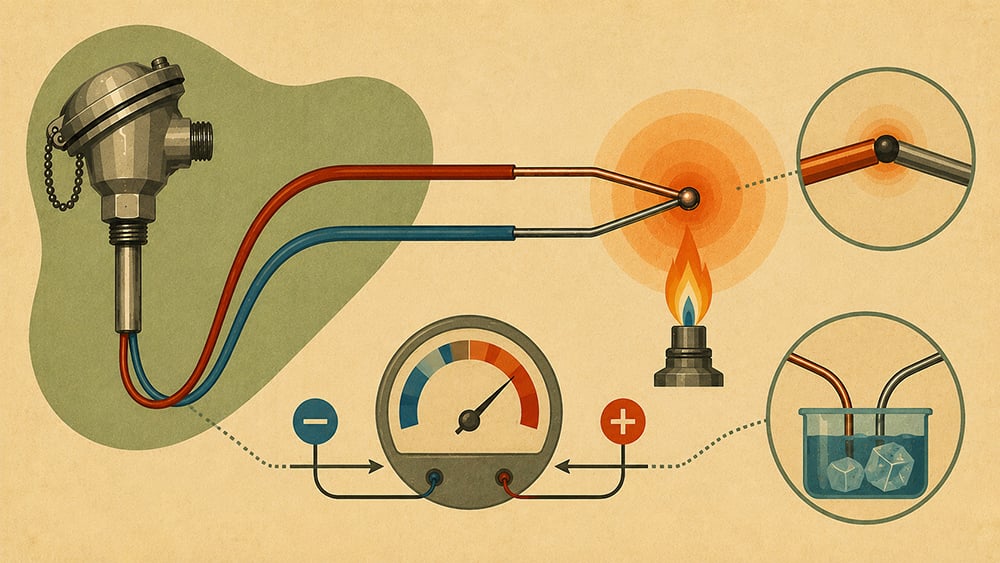
There are two types of thermocouple sensors, Type J and Type K:
These types of thermocouples cover different temperature ranges and suit various environments.
Resistance Temperature Detectors (RTDs) function on the principle that the electrical resistance of a pure metal increases with temperature. The most common metal is platinum, as it has a resistance-to-temperature relationship, plus it is a linear, repeatable, and extremely stable metal. The most commonly used standards are the PT-100 and the PT-1000 temperature probes. We should mention that RTD temperature sensors need an external excitation current; their signal conditioning is more complex, but the accuracy makes up for this.
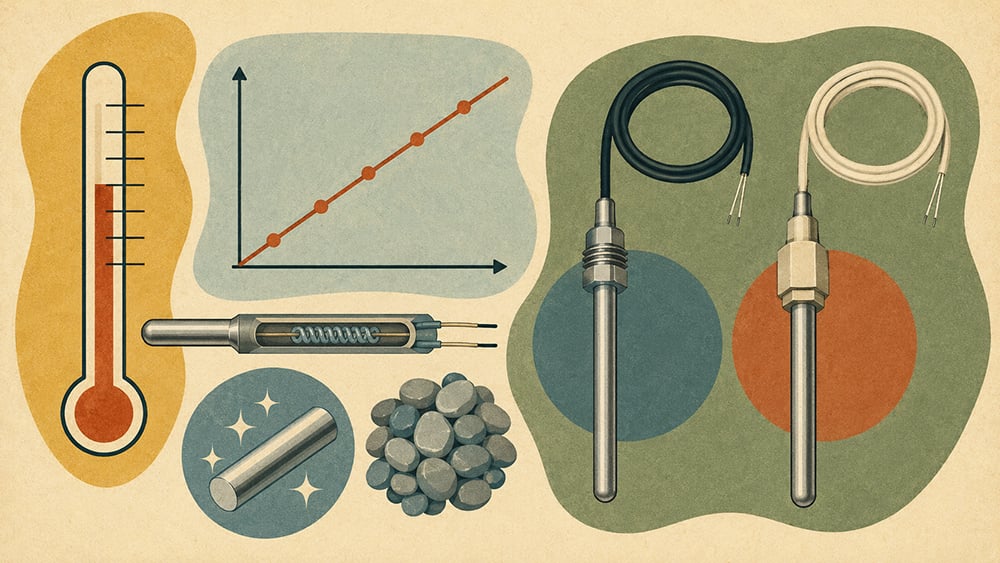
Thermistors are semiconductor instruments, typically made from metal oxides, whose resistance changes significantly with temperature. Unlike RTD temperature sensors, most thermistors exhibit a negative temperature coefficient (NTC). This means their resistance can fall quickly as temperature rises, making them very sensitive in a narrow temperature band, but highly nonlinear over a broad range.

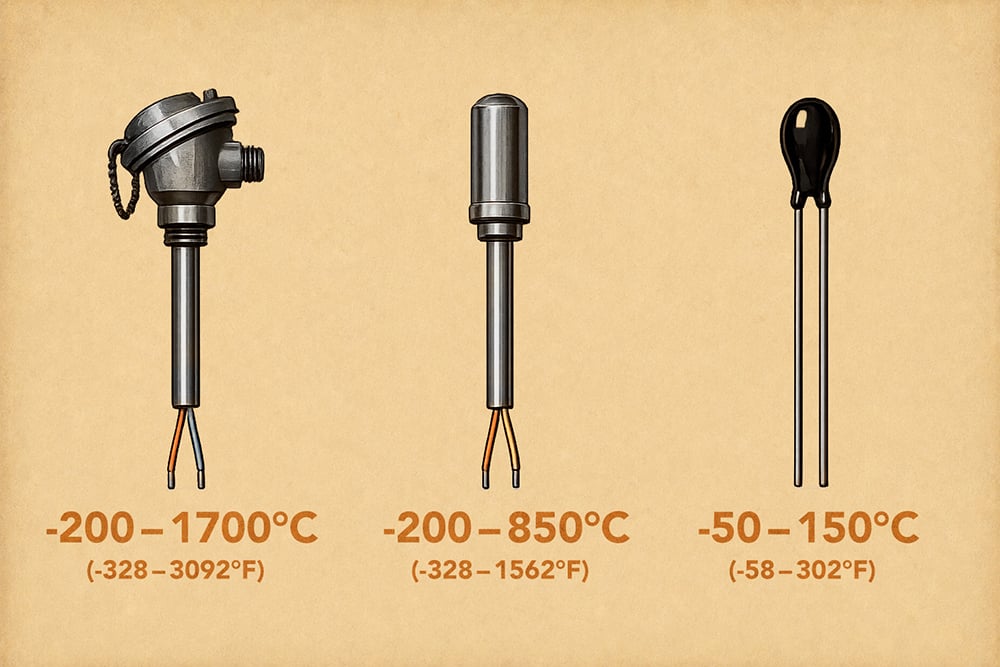
The biggest difference between temperature sensors is the range they can reliably handle. Thermocouples are the best for extreme-heat applications, measuring temperatures from -328℉ (-200℃) to 3092℉ (1700℃), depending on the metal pairing. This makes thermocouples the go-to temperature sensor for jet engines, furnaces, and extremely hot industrial environments. So, if your application is operating above 1112℉ (600℃), a thermocouple sensor is the most practical option.
RTDs are still very good as they also have a wide range. Most industrial platinum RTD sensors can handle temperatures from -328℉ (-200℃) up to 1562℉ (850℃). They are commonly used in food safety, pharma manufacturing, process monitoring, and water quality monitoring systems. The Atlas Scientific EZO RTD Temperature Circuit supports any PT-100 or PT-1000 temperature probe across a large sensing range, practically covering every real-world industrial application.
Lastly, thermistors have a much smaller range, limited to approximately -58℉ (-50℃) to 302℉ (150℃). However, within this small window, their sensitivity is remarkable. But push the boundaries, and the performance of thermistors rapidly degrades. This makes them best for medical devices, HVAC controls, and consumer electronics, yet terrible for very demanding industrial environments.
For applications where measurement drift can lead to product recalls, failed experiments, or not following the rules, accuracy and long-term stability are very important.
Across a wide range of temperatures, everyone agrees that RTDs are the most accurate of the three technologies. The resistance-to-temperature curve for platinum is one of the most accurately defined in all of engineering. It is the main reference standard used by national measurement bodies from -463°F (-260°C) to 1166°F (630°C). It is possible to make high-quality industrial RTDs that drift less than 32.18°F (0.1°C) per year, and precision laboratory-grade units can achieve stability of 32°F (0.0025°C) per year. Because of this, platinum RTD probes are the most common industrial standard for temperature measurement.
Thermistors can often outperform RTDs in terms of sensitivity because of their narrow operating range. However, their accuracy suffers and requires software to correct their significant nonlinearity. Also, they are the most likely to drift and be affected by self-heating from the measurement current.

Out of the three, thermocouples are the least accurate for general use, and they require watchful reference junction compensation to produce reliable readings. Over time, the sensor’s junction can also experience metallurgical changes that can cause calibration drift, notably at higher temperatures.
One of the most underestimated challenges is integrating a temperature sensor into an embedded system. This is where these three temperature sensors differ a lot.
Thermocouples produce very small millivolt-level signals that are easy to drown out by electrical noise. They also need a special thermocouple extension wire (made of the same metal as the sensor) and cold-junction compensation circuitry or ICs. These parts are well known, but they make the system more complicated and expensive.
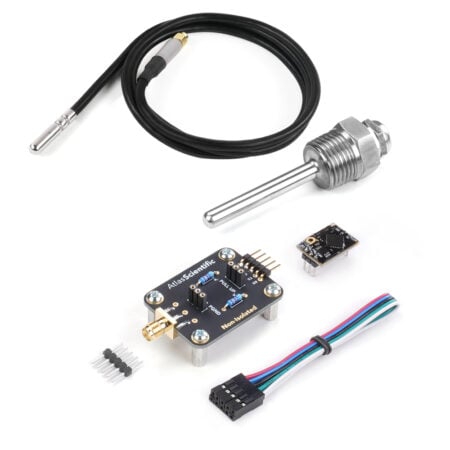
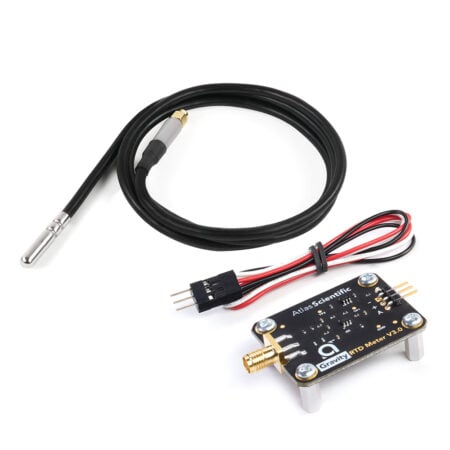
RTDs produce much larger output signals than thermocouples, but converting the resistance change to an accurate temperature reading demands analog signal conditioning. This is the exact challenge that Atlas Scientific has solved. We have designed the EZO RTD Temperature Circuit to handle all the signal conditioning internally. They are also ready to use in any Raspberry Pi, microcontroller, or Arduino-based system with minimal coding.
Thermistors are the simplest to interface at the hardware level, but the significant nonlinearity of their outputs requires careful software linearization, which can cause inaccuracies if not understood or handled properly.
In industrial settings, a sensor that fails early is worse than a temperature sensor that was never installed. Physical robustness is an essential decision factor.
Thermocouples are mechanically simple, and this simplicity makes them very rugged and resistant to vibration and shock, which is why they are often seen in harsh environments and heavy manufacturing applications.

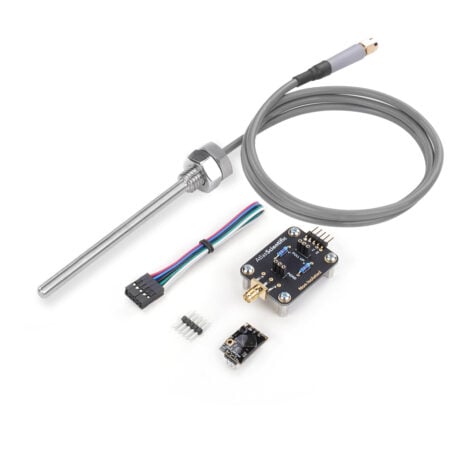
RTDs are accurate, yet they are more delicate. The platinum sensing element is composed of a fine wire; This can easily be damaged by vibration or mechanical stress. If you are working in a demanding field, choosing a properly housed industrial-grade temperature probe is critical. The Atlas Scientific Industrial PT-1000 Temperature Probe addresses this with a rugged stainless steel body built for real-world environments.
Thermistors are the most fragile as they are built from epoxy or glass. Therefore, they are not well-suited to high vibration or high-impact applications or environments.
Cost is rarely the decision maker, but it can narrow down the options depending on the application budget you have. Thermistors have the lowest component cost, making them popular for high-volume consumer products where unit economics are important. Yet, the cost advantage quickly narrows once protective housings, signal linearization, and calibration are accounted for.

In comparison, thermocouples are moderately priced for the sensor itself. However, the system cost rockets when reference junction compensation, specialized extension wire, and noise filtering are included. When the total cost of the signal chain is compared, RTDs often are lower than thermocouples. So RTDs – while these do require a higher component price, their precision, long lifespan, and stability override this. The Atlas Scientific temperature sensors are all designed to minimize that system burden that many operators worry about. The basic PT-1000 Temperature Probe and EZO RTD Temperature Circuit start low, making professional-grade RTD measurements very accessible for embedded system developers.
| Sensor Feature | Thermocouple | RTD (Platinum) | Thermistor |
| Temperature Range | -328℉ (-200℃) to 3092℉ (1700℃) | -328℉ (-200℃) up to 1562℉ (850℃) | -58℉ (-50℃) to 302℉ (150℃) |
| Accuracy | +/- 1 – 2℃ | +/- 0.1℃ or more | +/- 0.1 – 1℃ (narrow range) |
| Long-term Stability | Moderate | Excellent | Poor to moderate |
| Linearity | Moderate | Very good | Poor |
| Sensitivity | Low | Moderate | Very high |
| Ruggedness | High | Moderate | Low |
| Signal Complexity | High | Moderate | Low |
| Best Use For | Extreme heat | Industrial/lab precision | HVAC/consumer |
Selecting a temperature sensor essentially comes down to your operating environment and needs. Remember:
At Atlas Scientific, we have manufactured our temperature sensors around platinum RTD technology as they deliver results that thermistors and thermocouples cannot match.
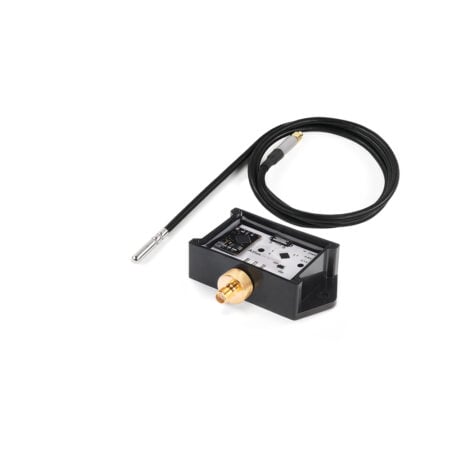
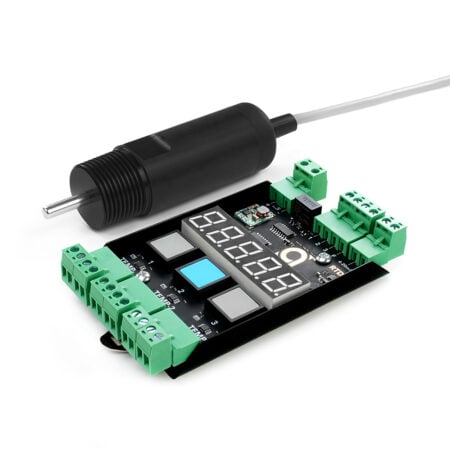
The Atlas Scientific temperature range covers every deployment you can imagine, from our compact Micro PT-1000 Temperature Probe for space-constrained builds, to the RTD3 Industrial Temperature Transmitter for 4-20mA loop integration, to one of our most popular, the Industrial RTD Temperature Kit for durable process monitoring.
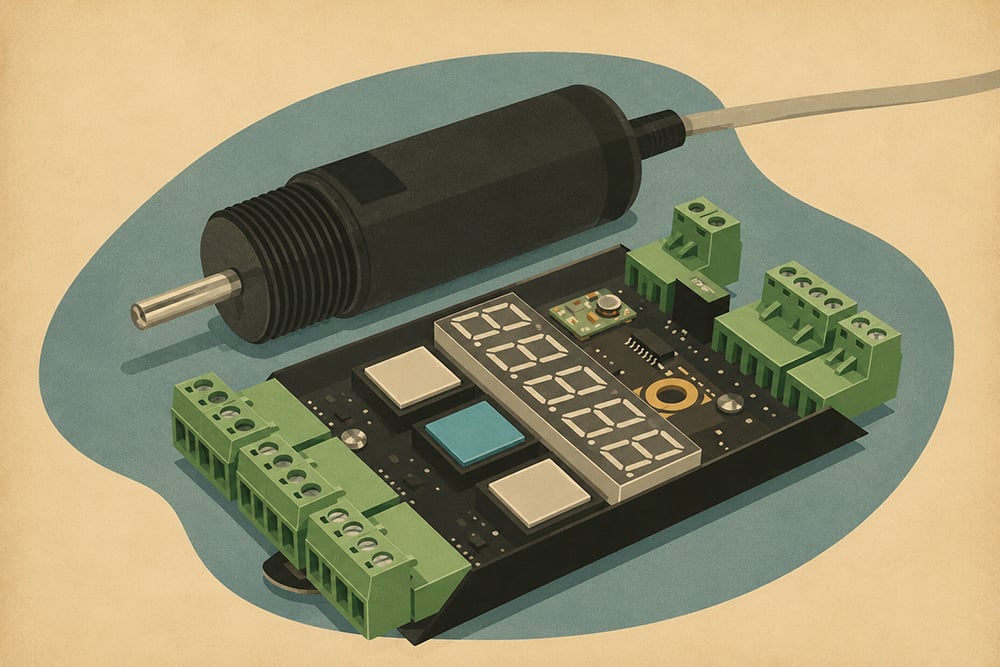
If you are unsure which temperature probe is best suited for your application, the Atlas Scientific Temperature Probe Selection Guide walks you through each sensor step by step, or you can contact the world-class team at Atlas Scientific for expert advice.
Indoor air quality can have a major impact on the comfort and productivity of homes, offices, schools, laboratories, and industrial facilities. Carbon dioxide buildup, poor
UART and I2C are serial communication protocols, but they serve different purposes. UART is typically used for direct device-to-device communication and requires dedicated connections. I2C